
SEO Isn't Dead. But It's Not Enough Anymore: Why AI Visibility Is the Next Layer Your Business Needs

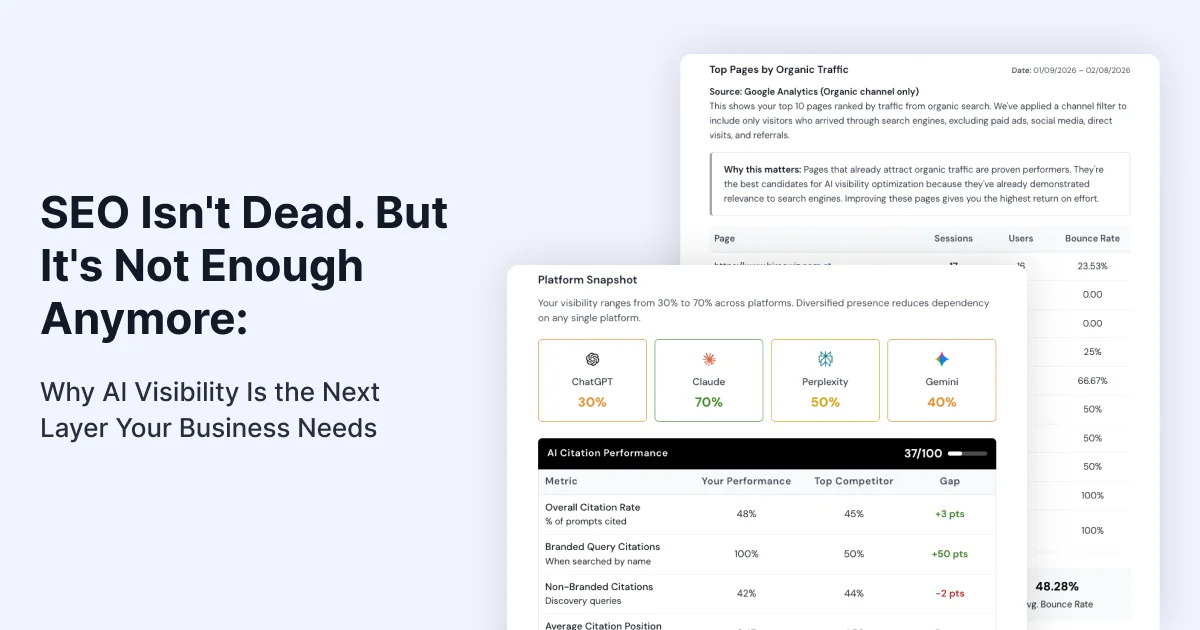
Last year, one of our clients typed their most important service into ChatGPT. Their top competitor came up. They didn't. They tried Perplexity. Same result. Google's AI Overview recommended three companies. Theirs wasn't one of them.
Twenty years of reputation, and AI didn't even know they existed.
If that makes you nervous about your own SEO investment, hold on. Don't pull the plug. Google still drives 345 times more traffic than all AI platforms combined (Ahrefs/SparkToro, 2025). Your SEO investment is working. The rankings you've built, the organic traffic you're generating, the leads coming through your website. That's real. Anyone telling you to abandon it is wrong.
But here's the honest truth: SEO alone isn't capturing the full picture of how your customers find you anymore. And if you stop there, you're leaving a growing share of high-quality leads on the table.
At HireAWiz, we've been building websites and running SEO campaigns for over 25 years. We've seen the results firsthand. One of our long-term clients, Todd Whittaker Drywall, saw a 600% increase in traffic and now generates over $1 million in annual revenue through the online presence we built together. That happened because of strong SEO foundations.
And we're still all-in on SEO. What's changed is that we've added a layer on top of it, because the data says that's where the next wave of growth is coming from.
Table of Contents
- Something Is Shifting in How People Search
- Two Different Games: Why Google Rankings Don't Guarantee AI Visibility
- The Growth Stack: How SEO and AI Visibility Fit Together
- What SEO Gives You (and What It Doesn't)
- The Leaky Bucket (and Why Order Matters)
- What This Means for Your Business
- Get Your Free Website Audit
- Frequently Asked Questions
Something Is Shifting in How People Search
You've probably noticed it yourself. You ask ChatGPT a question instead of opening Google. You type a problem into Perplexity and get a direct answer with sources. Your phone's assistant gives you a recommendation before you even finish the question.
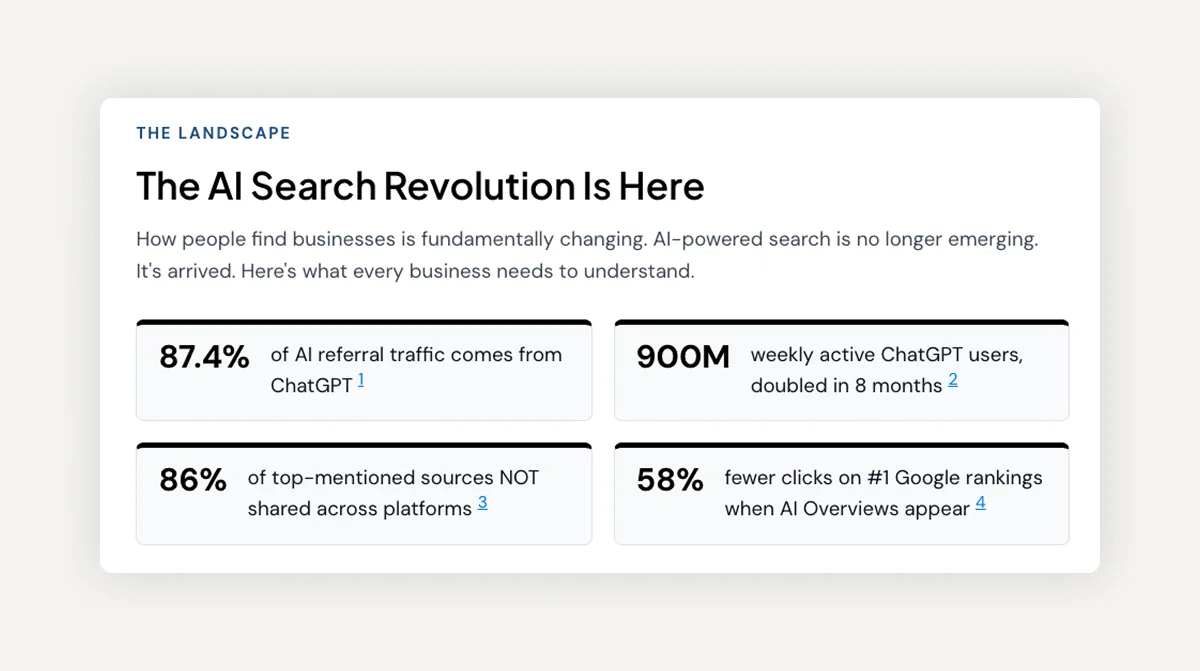
You're not alone. ChatGPT now has 800 million weekly active users (OpenAI, October 2025). That number doubled in just eight months. And 77% of those users treat it as a search engine (Adobe, May 2025). They're not writing code or playing with AI for fun. They're finding businesses, comparing services, and making buying decisions.
Here's what makes this different from traditional search: AI platforms don't show a list of ten blue links and ads. They recommend specific businesses by name. Either your company is the one getting mentioned, or your competitor is.
And the visitors who come through AI referrals? They convert at 4.4 times the rate of traditional search visitors (Ahrefs/Datos, 2025). That's not a rounding error. That's a fundamentally different quality of lead. These people have already been pre-sold by the AI's recommendation before they ever hit your website.
AI-referred traffic has also grown over 1,200% year-over-year (SparkToro/Datos, 2025). It's still a fraction of Google's volume, but it's the fastest-growing search channel most businesses are ignoring.
Two Different Games: Why Google Rankings Don't Guarantee AI Visibility
This is the part that surprises most business owners and marketing directors.
You'd think that if you rank well on Google, you'd automatically show up when someone asks ChatGPT or Perplexity for a recommendation. It seems logical. But it's not how it works.
Research from Ahrefs analyzing millions of AI interactions found that 80% of the sources cited by AI platforms are NOT in Google's top 100 results for the same query (Ahrefs, August 2025). Read that again. Four out of five businesses that AI recommends aren't even ranking on the first ten pages of Google for those terms.
That means Google rankings and AI citations are correlated but not the same. They share some of the same foundation signals (authority, trust, quality content), but they evaluate and select businesses through different processes.
A company can be #1 on Google and completely invisible on ChatGPT. And a company that barely cracks page two of Google can be the first business ChatGPT recommends when a potential customer asks for help.
This isn't a criticism of SEO. It's an honest look at where SEO's coverage ends and where a growing blind spot begins. If your SEO is strong, that's a real advantage. But it doesn't automatically translate to the AI platforms where an increasing share of your customers are looking.
Meanwhile, AI is also changing Google itself. Ranking #1 on Google now gets 58% fewer clicks when an AI Overview appears above the organic results (Ahrefs, February 2025). About 25% of Google searches already trigger these AI-generated summaries (Conductor, November 2025), and that number is climbing. Even within Google, the rules are changing.
The Growth Stack: How SEO and AI Visibility Fit Together
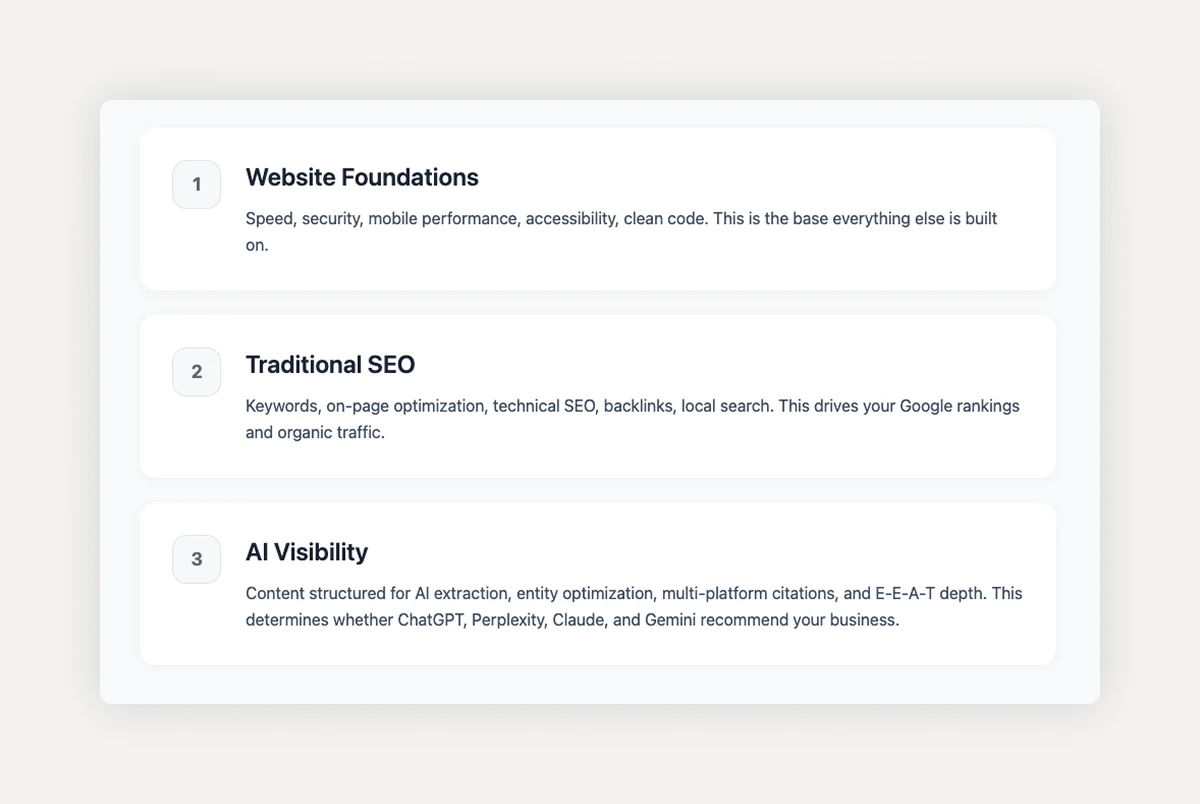
At HireAWiz, we use a framework we call the Growth Stack. It's how we think about the relationship between the different layers of search visibility, and it explains why this is a "both, and" conversation rather than an "either, or."
Layer 1: Website Foundations. Speed, security, mobile performance, accessibility, clean code, site architecture. This is the base everything else is built on. If your website is slow, hard to navigate, or poorly structured, nothing else works well.
Layer 2: Traditional SEO. Keywords, on-page optimization, technical SEO, backlinks, local search, Google Business Profile. This is what drives your Google rankings and organic traffic. It's the engine that's been generating leads for you.
Layer 3: AI Visibility. Content structured for AI extraction, schema markup, entity optimization, multi-platform citation building, and E-E-A-T depth (Experience, Expertise, Authoritativeness, and Trustworthiness). This is the layer that determines whether ChatGPT, Perplexity, Claude, and Gemini recommend your business when a potential customer asks.
The principle is simple: you build from the bottom up. If Layer 1 has gaps, fix those before worrying about Layer 3. AI systems can't cite content they can't crawl, from a site they don't trust, that loads too slowly to index properly.
Here's the good news for businesses already investing in SEO: if your foundation is solid, you're already 60 to 70 percent of the way there. AI visibility builds on the same core signals that make SEO work. Domain authority, quality content, backlinks, trust signals, structured data. The overlap is significant.
The gap is specific. It's in how your content is structured for AI extraction. It's in whether your business has consistent entity signals across the web. It's in the depth of your E-E-A-T profile: do AI systems trust your expertise enough to recommend you by name? And it's in whether you're testing and monitoring your presence across multiple AI platforms, not just Google.
This is where the industry terms come in, in case you've seen them. AEO (Answer Engine Optimization) is the practice of optimizing your business to be cited by AI-powered search platforms. GEO (Generative Engine Optimization) focuses on how your content appears within AI-generated responses. Together with traditional SEO, they form the complete Growth Stack.
Want to see where your SEO foundation stands and where the AI visibility gaps are?
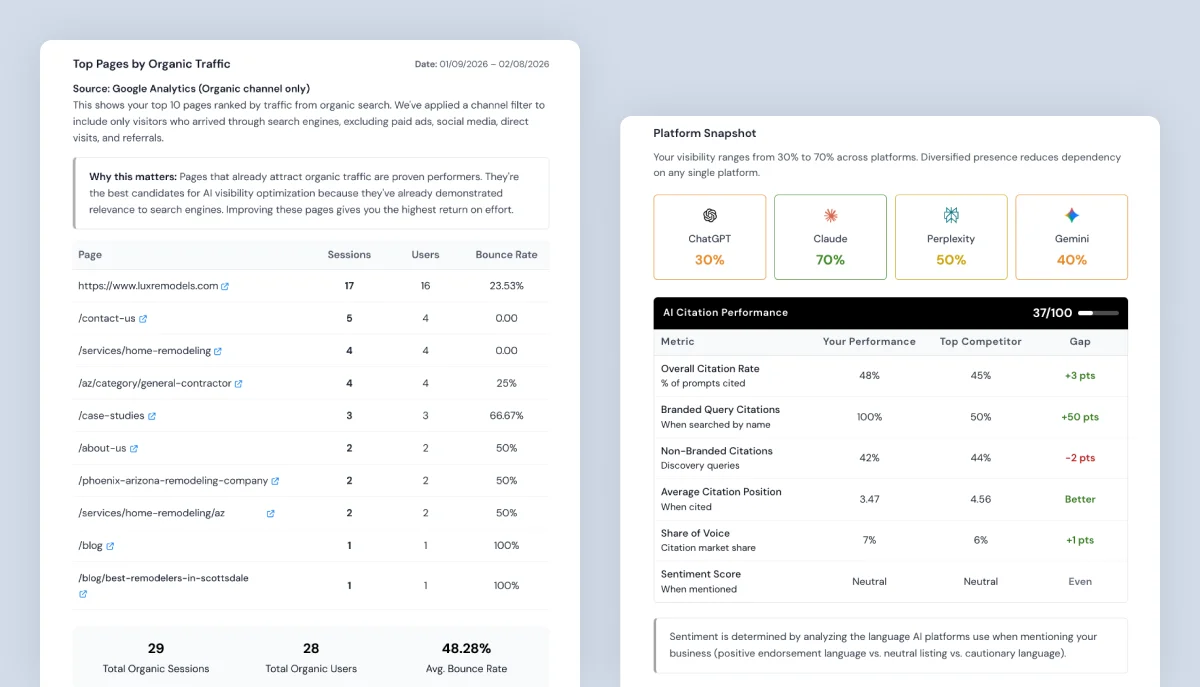
Our AI Visibility Audit tests your business across ChatGPT, Claude, Perplexity, and Gemini alongside your traditional search presence. It shows exactly where you're strong and where you're invisible.
What SEO Gives You (and What It Doesn't)
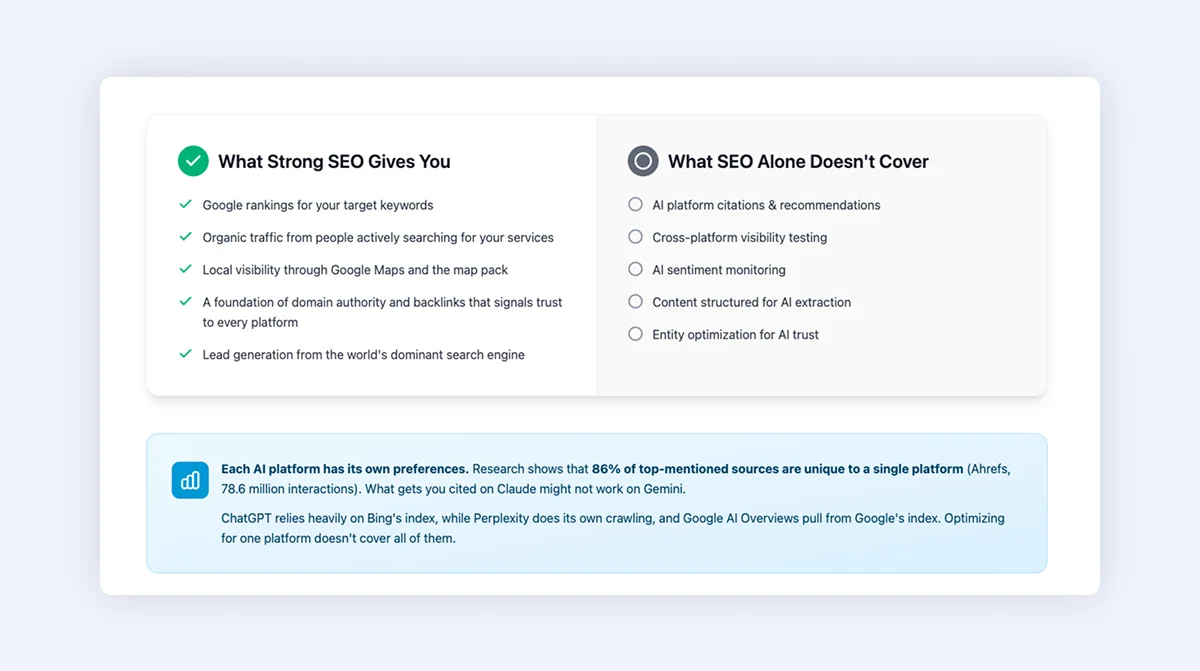
A clear-eyed look at this helps explain why both layers matter.
What strong SEO gives you: Google rankings for your target keywords. Organic traffic from people actively searching for your services. Local visibility through Google Maps and the map pack. A foundation of domain authority and backlinks that signals trust to every platform. Lead generation from the world's dominant search engine.
What SEO alone doesn't automatically give you: Visibility when someone asks ChatGPT, Perplexity, Claude, or Gemini for a recommendation in your industry. Citation testing across AI platforms to know whether you're being mentioned, ignored, or described inaccurately. Sentiment monitoring for how AI platforms characterize your business (a citation paired with cautionary language can actually hurt more than no citation at all). Content structured specifically for AI extraction and attribution. Entity optimization that helps AI systems understand who you are, what you do, and why you're credible.
Each AI platform also has its own preferences. Research shows that 86% of top-mentioned sources are unique to a single platform (Ahrefs, 78.6 million interactions). What gets you cited on Claude might not work on Gemini. ChatGPT relies heavily on Bing's index, while Perplexity does its own crawling, and Google AI Overviews pull from Google's index. Optimizing for one platform doesn't cover all of them.
None of this makes SEO less valuable. It means SEO is necessary but no longer sufficient on its own. The total opportunity for your business now spans more platforms than Google alone.
The Leaky Bucket (and Why Order Matters)
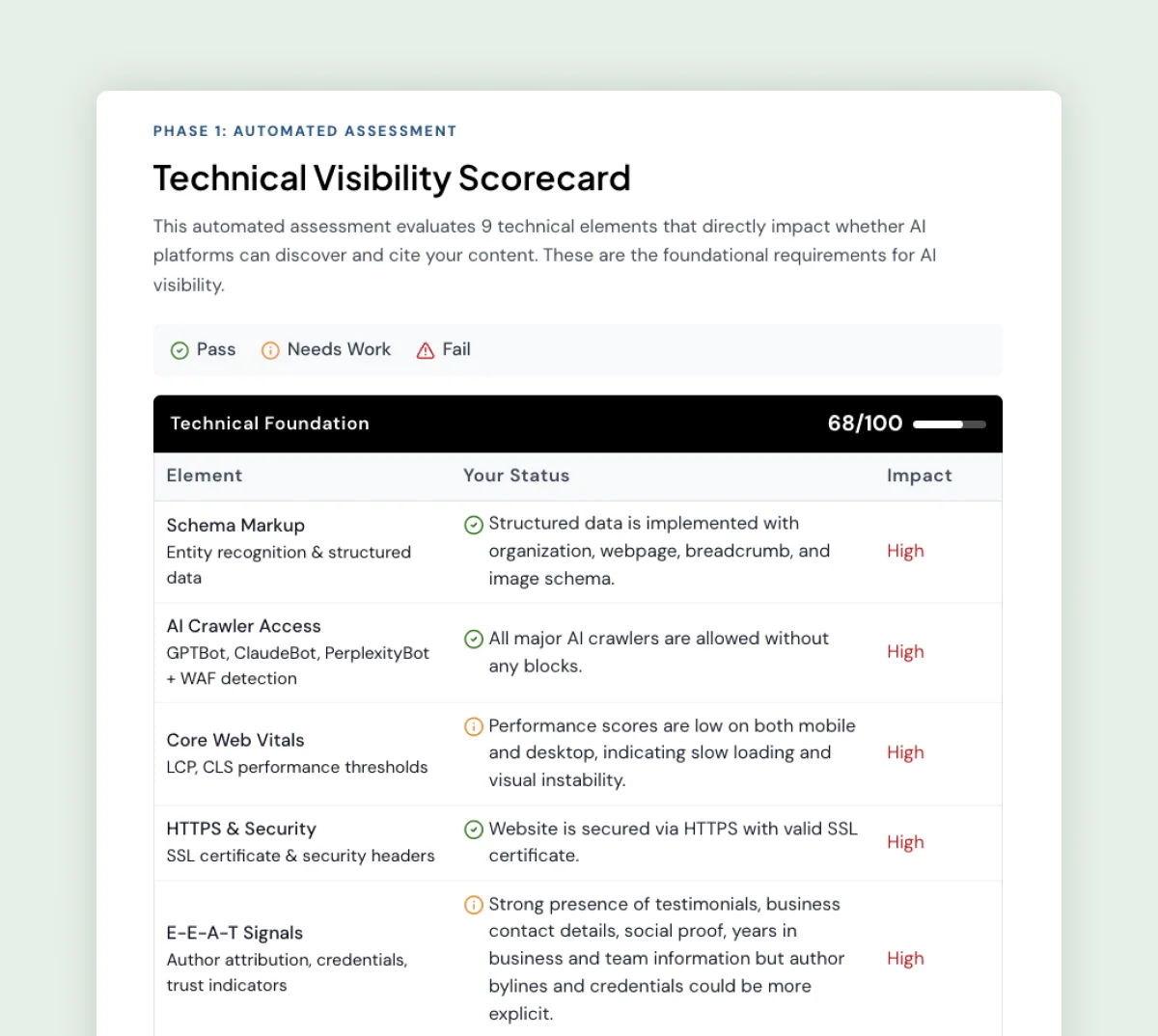
There's a concept we use with clients that explains why the Growth Stack matters in sequence, not just in theory.
Picture pouring water into a bucket with holes in the bottom. You can pour faster and faster, but the bucket never fills until you patch the holes.
Content strategy works the same way. A business can invest in great AI-optimized content, but if the technical foundations aren't in place, that content won't earn the citations it deserves. If AI crawlers are blocked from your site, if there's no schema markup telling them what your business does, if the site loads slowly, if there's no clear authorship on your content, the effort leaks out the bottom.
This is actually an argument against the "skip SEO, just do AI visibility" crowd. The businesses that perform best in AI search are the ones with strong SEO foundations already in place. AI platforms favor domains with strong backlink profiles. They favor recently updated content (AI systems prefer content that's 25.7% fresher than what traditional search surfaces, according to Ahrefs, 2025). They favor sites with structured data and clear E-E-A-T signals. These are the same things good SEO builds.
The order matters. Fix the foundations first. Build SEO strength second. Add the AI visibility layer third. Each layer makes the next one more effective.
This is also why HireAWiz handles all three layers under one roof. Separate providers for website, SEO, and AI visibility create coordination gaps between the layers. An integrated approach means each layer reinforces the others from day one.
What This Means for Your Business
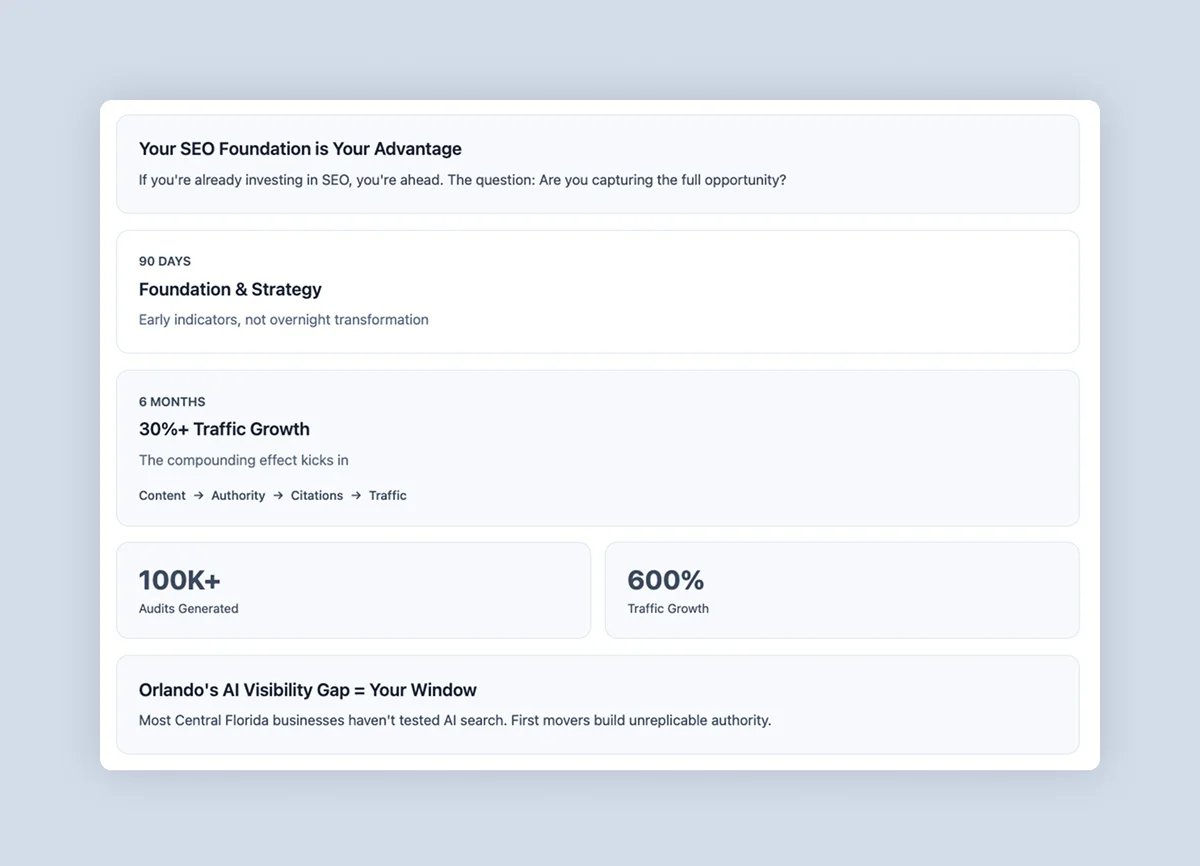
If you're already investing in SEO, you're in a stronger position than you might realize. The foundation you've built is exactly what AI visibility needs to work.
The question isn't whether your SEO was worth it. It was. The question is whether you're capturing the full opportunity or leaving a growing share of it on the table.
Here's a realistic picture of what adding the AI visibility layer looks like. In the first 90 days, the focus is on fixing technical foundations and building strategy. You'll see early indicators of improvement, not overnight transformation. Within six months, with the content strategy in motion and the foundation solid, 30% or more improvement in relevant traffic metrics becomes achievable. That's when the compounding effect kicks in: content builds authority, authority earns citations, citations drive traffic, traffic validates the investment.
We're not guessing at this. HireAWiz founder Cliff Almeida built My Web Audit, a SaaS audit platform whose users have generated over 100,000 audits for hundreds of agencies worldwide. The methodology behind our AI Visibility Audit is informed by that depth of data across thousands of real businesses in every industry. We know what moves the needle because we built the tools that measure it.
And we've been doing the SEO and web design work that forms the foundation for over 25 years. The Todd Whittaker Drywall results, that 600% traffic growth and $1M+ in annual revenue, came from exactly the kind of SEO and web design foundation that AI visibility builds on. The difference now is that we're extending that proven approach to include the platforms where more and more of your customers are searching.
The AI visibility opportunity in Orlando is wide open right now. Most businesses in Central Florida haven't even started thinking about whether they show up in AI search results. That means the businesses that move first have a real window to build authority that competitors will struggle to replicate later.
Most business owners we talk to haven't tested what happens when someone asks AI for their service. When they do, the reaction is almost always the same: they had no idea their competitors were already being recommended while they were invisible. That gap is the whole story.
Get Your Free Website Audit
Our audit shows both the SEO foundation and the AI visibility gaps, making it the right next step for businesses that already have SEO in place and want to see where they stand on AI search. The audit tests real prompts your customers would ask across ChatGPT, Claude, Perplexity, and Gemini, and gives you a clear picture of what's working, what's missing, and what to do about it.
Get Your Free Website Audit.
See your SEO foundation and AI visibility gaps side by side — with real prompts your customers are already asking.
Frequently Asked Questions
Should I stop investing in SEO if AI search is growing?
No. Google drives 345 times more traffic than all AI platforms combined. SEO remains the foundation of search visibility. AI visibility is an additional layer built on top of that foundation, not a replacement. The businesses that perform best in AI search are the ones with strong SEO already in place.
How are SEO and AEO (Answer Engine Optimization) different?
SEO optimizes your presence for traditional search engines like Google, focusing on keywords, backlinks, and technical factors to improve rankings. AEO optimizes your presence for AI-powered platforms like ChatGPT, Perplexity, Claude, and Gemini, focusing on content structure, entity signals, and trust depth so these platforms recommend your business by name.
Does good SEO automatically help with AI visibility?
Partially. Strong domain authority, quality content, and backlinks are signals that both Google and AI platforms value. But 80% of sources cited by AI platforms aren't in Google's top 100 results. AI visibility requires additional work on content structure, schema markup, entity optimization, and multi-platform monitoring that traditional SEO doesn't cover.
Can my current SEO provider handle AI visibility too?
Some can, most can't yet. AI visibility requires different tools, different testing methodologies, and expertise in how each AI platform evaluates and recommends businesses. Ask your provider whether they test citations across ChatGPT, Claude, Perplexity, and Gemini, and whether they monitor how AI describes your business. If the answer is no, you may need a specialized partner for the AI visibility layer.
How do I know if my business has AI visibility gaps?
The fastest way is an AI Visibility Audit. It tests real prompts your potential customers would ask across four major AI platforms and shows whether your business is being cited, ignored, or mentioned with inaccurate information. Most businesses are surprised by what they find.
What is the Growth Stack approach to search visibility?
The Growth Stack is a three-layer framework: Website Foundations (speed, security, architecture), Traditional SEO (keywords, backlinks, local search), and AI Visibility (AEO/GEO, content structure, entity optimization). You build from the bottom up, and each layer makes the next one more effective. Businesses with strong SEO foundations are already 60 to 70 percent of the way to AI visibility readiness.

Related Articles
Most SEO guides feel like they were written for everyone, which means they were written for no one. This one…
Everyone selling digital marketing has a different answer to the same question: “What does my business actually need?” One vendor…
An AEO audit (answer engine optimization audit) answers a question most business owners haven’t thought to ask: when someone uses…
Ready to Find Out Where You Stand?
No pitch. No pressure. Just a conversation about what's working, what's not, and where the opportunity is.
The AI Visibility Audit is free and shows you exactly how your business appears across ChatGPT, Perplexity, Claude, and Gemini before you invest a dollar.

5.0


