
The Growth Stack: How Your Website, SEO, and AI Visibility Work Together

Everyone selling digital marketing has a different answer to the same question: "What does my business actually need?"
One vendor says you need a new website. Another says SEO. Someone on LinkedIn just told you that AI search optimization is the future and if you're not doing it, you're already behind. A marketing conference you attended last month added AEO, GEO, and "entity optimization" to the list. Your inbox has three proposals, each one recommending something different.
If you're a business owner trying to figure out where to invest, this is overwhelming. If you're a marketing director trying to present a coherent strategy to leadership, it's worse. Nobody wants to bring the C-suite a grab bag of disconnected tactics and hope it looks like a plan.
Here's the good news: your website, SEO, and AI visibility aren't three separate strategies competing for your budget. They're three layers of the same system, and they work best when they're built in the right order.
At HireAWiz, we call this system the Growth Stack. It's the framework we use for every client engagement, whether we're working with an Orlando contractor or a national e-commerce brand. It brings clarity to the noise and answers the question every business owner eventually asks: "Where do I start?"
What the Growth Stack Is
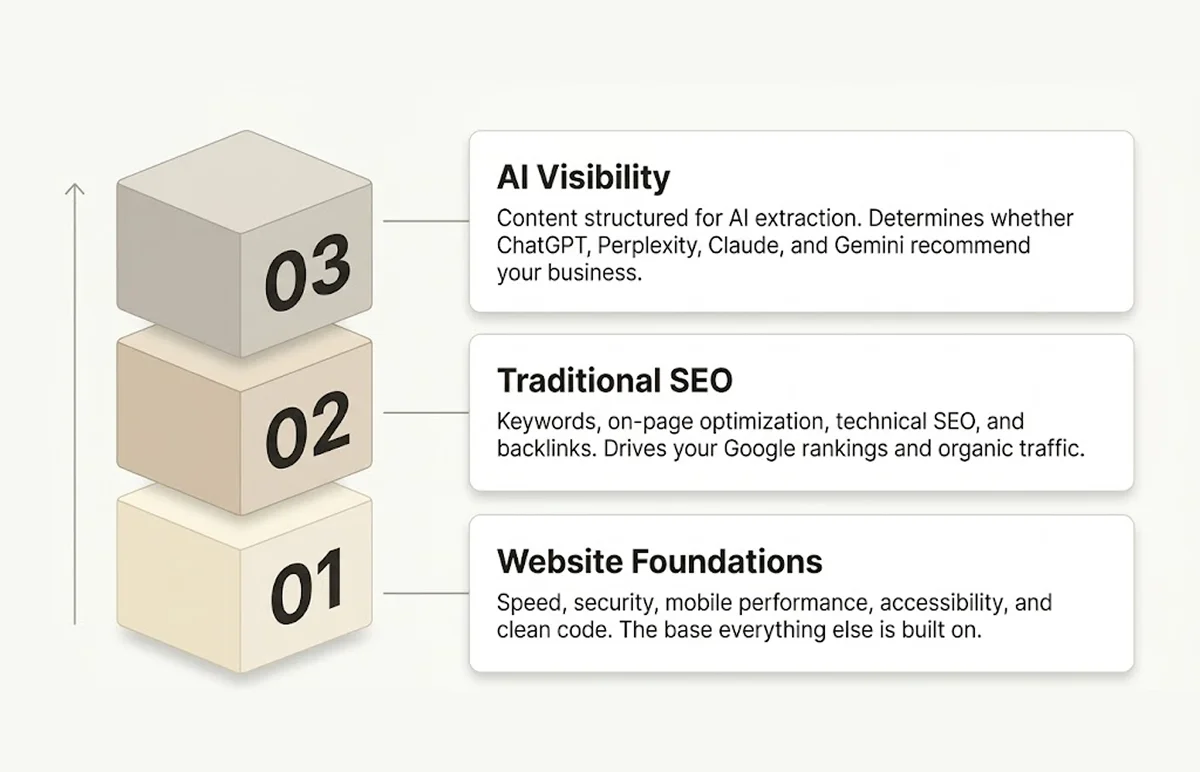
The Growth Stack is a three-layer approach to digital visibility:
Layer 1: Website Foundations. The technical infrastructure that makes everything else possible.
Layer 2: Traditional SEO. The practice of getting found on Google for the searches that matter to your business.
Layer 3: AI Visibility (AEO + GEO). The practice of getting cited and recommended by AI platforms like ChatGPT, Gemini, Perplexity, and Claude.
The rule is simple: you build from the bottom up. If Layer 1 has gaps, don't skip to Layer 3. AI systems can't cite content they can't crawl, from a site they don't trust, that loads too slowly to index.
This framework comes from 25+ years of building websites, running SEO campaigns, and studying how search is evolving. It's also informed by the 20,000+ hours of R&D that went into building My Web Audit, the SaaS audit platform I created that hundreds of agencies worldwide now use to evaluate websites and AI visibility. When you've powered over 100,000 audits across web design, SEO, and AI visibility, you start to see the patterns clearly. The businesses that grow fastest are the ones who get these three layers working together.
Layer 1: Website Foundations
This is the plumbing. It's not glamorous, and no one gets excited about it at a dinner party. But without it, nothing else works.
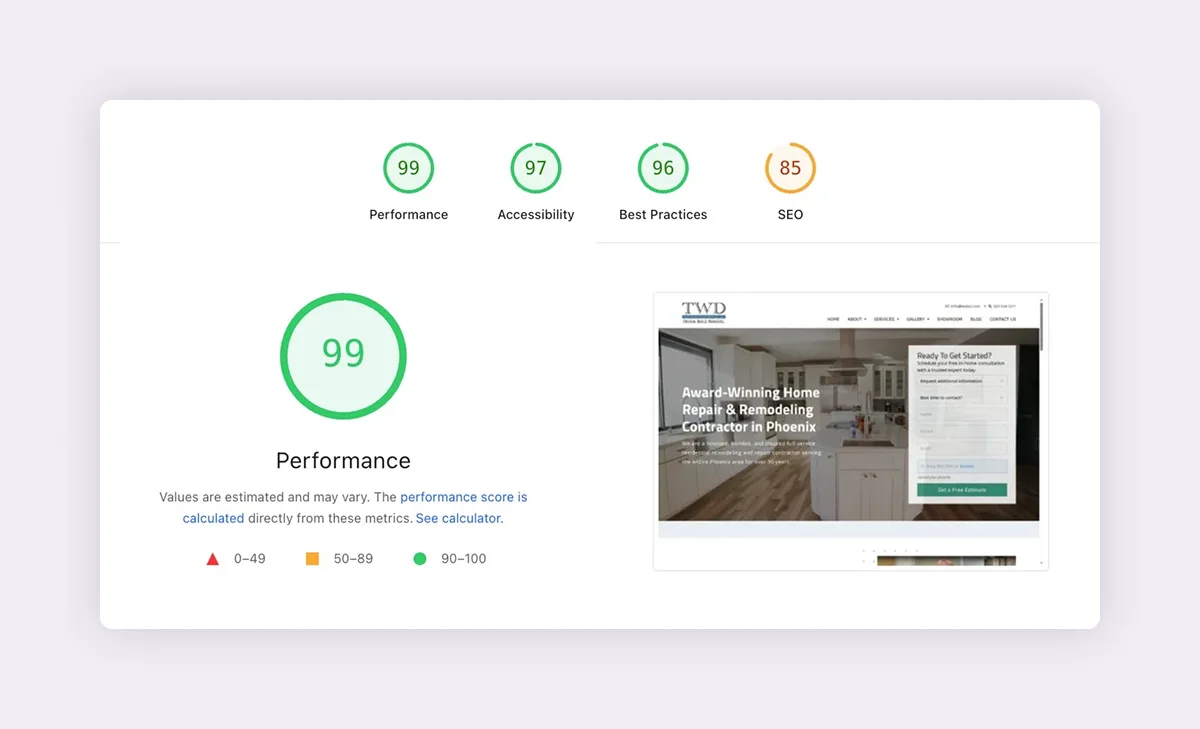
Website foundations include site speed, security (SSL), mobile responsiveness, site architecture, content rendering, accessibility, and clean semantic HTML. These are the technical elements that determine whether search engines and AI platforms can find, crawl, and understand your content in the first place.
Why it matters: Google can't rank what it can't crawl. AI platforms can't cite content from a site that loads too slowly or renders important information only through JavaScript that their crawlers can't execute. If your site takes five seconds to load on a phone, both human visitors and AI crawlers are moving on to someone else.
What it includes: Core Web Vitals performance (how fast your site loads and how stable it feels), clean site structure and navigation, a content management system that doesn't fight you, proper hosting, server-side rendering of important content, and a mobile experience that actually works.
What happens when you skip it: Think of it as a leaky bucket. You can pour the best content and the most aggressive SEO effort into a site with technical problems, but the results leak out through the gaps. I've seen businesses invest thousands in content marketing while their site scored in the red on every speed metric Google measures. They wondered why nothing was sticking. The foundation was broken.
53% of mobile visits are abandoned when load times exceed three seconds (Google/Think with Google). 70% of consumers say page speed affects their willingness to buy (Statista, 2024). Those aren't abstract numbers. They're customers walking out the door before they ever see what you offer.
HireAWiz has built over 500 websites since 2001. This layer is where we started, and it's where every client engagement begins. We've watched clients go from mobile speed scores in the 20s to the high 80s after a foundation rebuild. When that happens, bounce rates drop, time on site climbs, and every piece of content starts performing better because the container holding it actually works.
That's the foundation. Now let's talk about the engine that sits on top of it.
Layer 2: Traditional SEO
Google still drives 345 times more traffic than all AI platforms combined (Dataslayer, 2025).
Read that again. For all the buzz about AI search, Google is still where the vast majority of your customers find you. SEO is the foundation of digital visibility and the engine that puts leads in your pipeline right now.
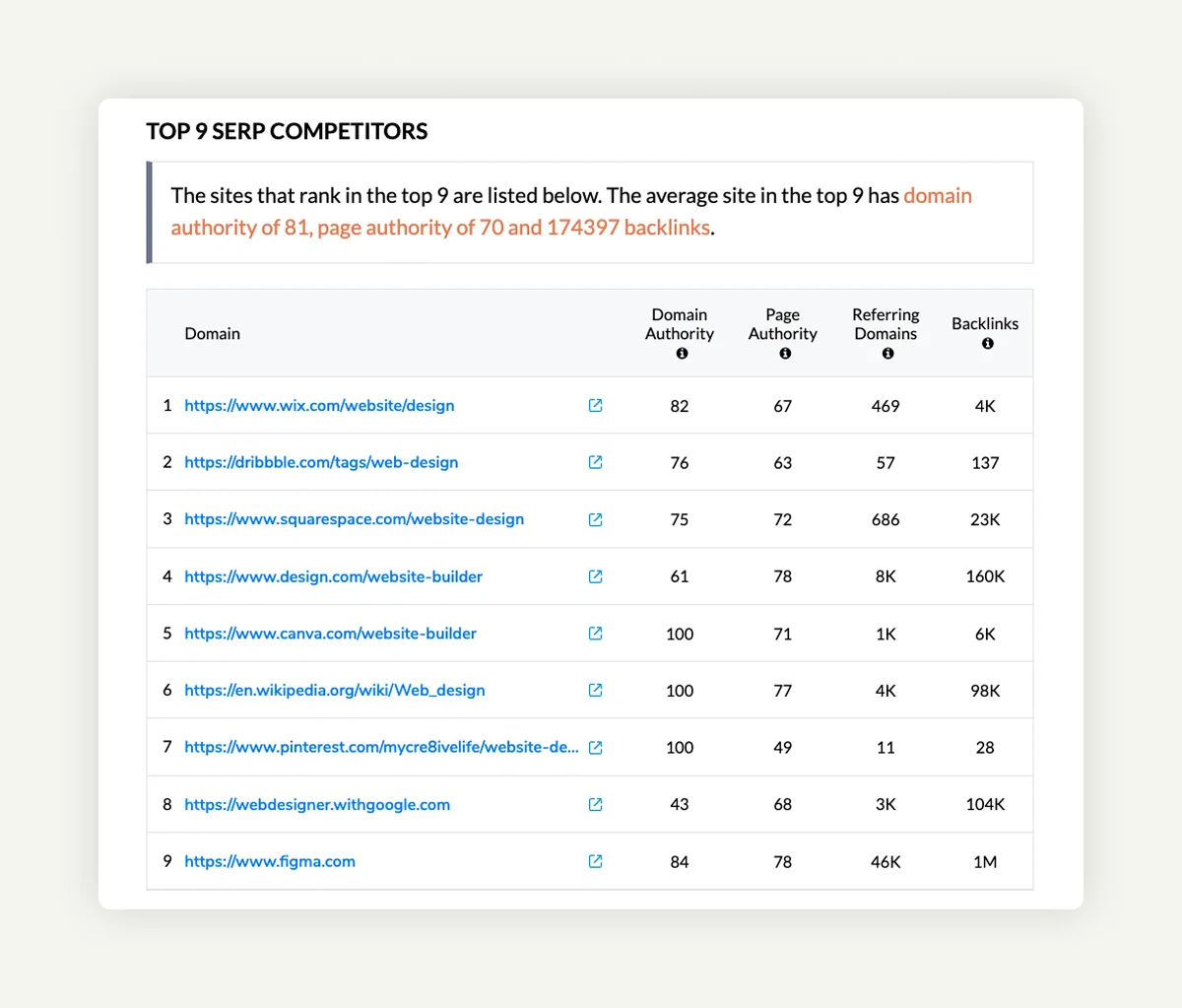
Traditional SEO is the practice of getting your business found on Google when people search for what you sell. On the content side, that means keyword strategy, on-page optimization, and building E-E-A-T signals (Experience, Expertise, Authoritativeness, Trustworthiness) throughout your site. On the technical side: crawlability, indexing, site structure, and schema markup implementation. On the local front: Google Business Profile optimization, review generation and management, and local citation consistency.
There's a connection here that ties the whole Growth Stack together. The same signals that help you rank on Google (strong backlinks, consistent business information, positive reviews, expert content) are exactly what AI platforms evaluate when deciding who to recommend. SEO and AI visibility aren't parallel tracks. They're the same track.
Skip this layer and you have a beautiful website nobody finds. Worse, you lose the very authority signals that AI platforms need to see before they'll recommend you to anyone. Layer 2 feeds Layer 3 directly.
Here's a proof point. Todd Whittaker Drywall came to us as a regional contractor. Through a combination of web design and SEO built on the Growth Stack approach, they went from a Top 500 to a Top 100 home remodeling company nationally. Traffic grew by 600%. Annual revenue from digital channels exceeded $1 million. That didn't happen because of any single tactic. It happened because the layers worked together.
The first two layers are about making sure you're findable on Google. The third is about a channel most of your competitors haven't touched yet.
Layer 3: AI Visibility (AEO + GEO)
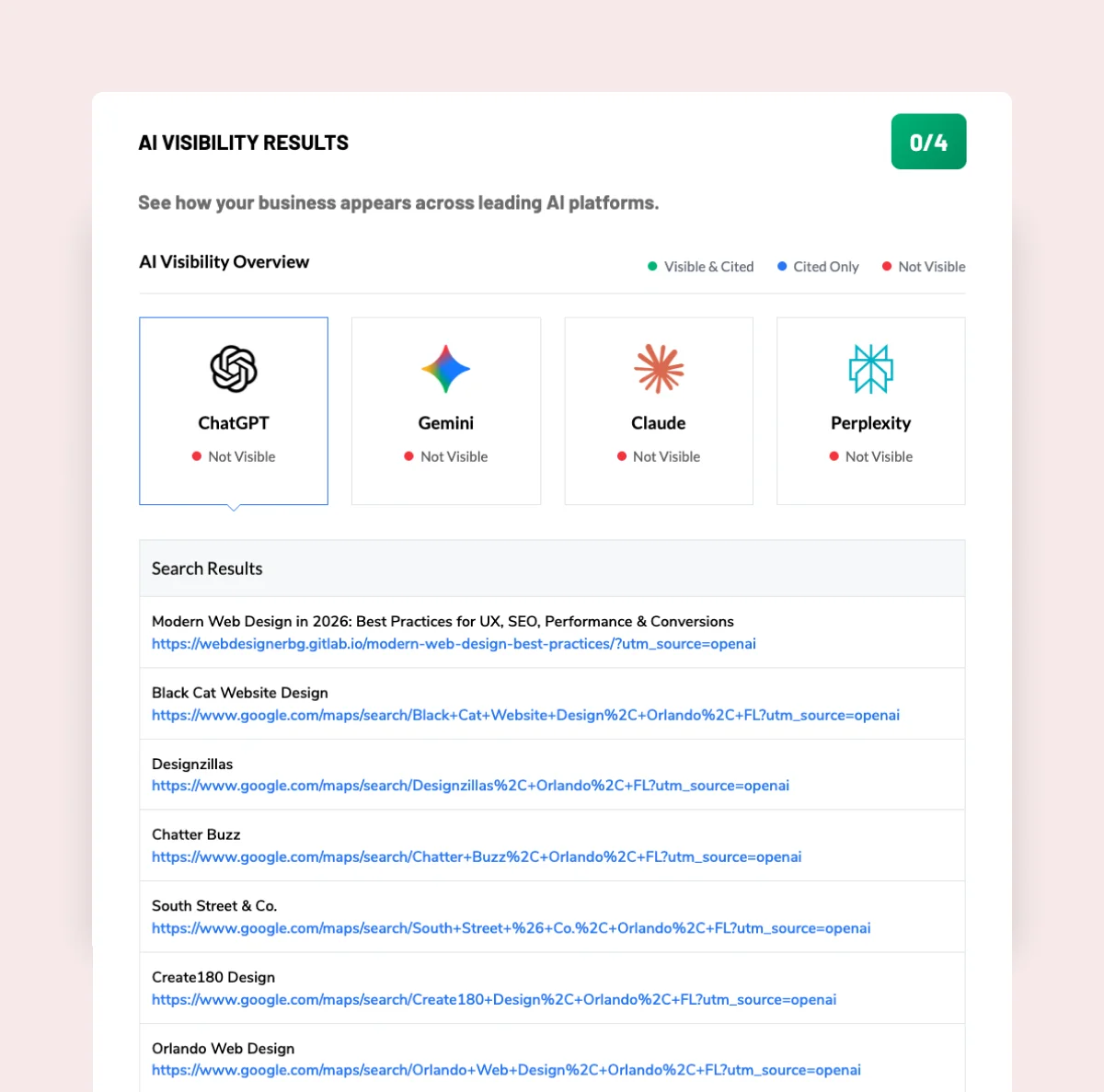
Here are three numbers worth sitting with.
ChatGPT now has 800 million weekly active users (OpenAI, October 2025). That number doubled in eight months. 77% of those users treat it as a search engine (Adobe, May 2025). And visitors who come to your website from AI platforms convert at 4.4 times the rate of traditional search visitors (Semrush, 2025).
These aren't tire kickers. They're people who got a specific recommendation and are ready to take action. Traffic from AI platforms grew over 1,200% in a single year (Adobe Analytics, 2025). That kind of acceleration hasn't happened in search since Google itself was young.
So what is AI visibility? When someone asks ChatGPT "What's the best web design company in Orlando?" or tells Perplexity "I need a contractor for a kitchen remodel," these platforms don't show ten blue links. They recommend specific businesses by name. Either you're the one getting recommended, or you're losing customers to whoever is.
Two terms you'll hear in this space:
AEO (Answer Engine Optimization) is about structuring your content so AI platforms can extract clear, accurate answers and cite your business when people ask relevant questions.
GEO (Generative Engine Optimization) is the broader practice of optimizing your entire digital presence so generative AI systems recommend you across different platforms and prompt types.
The work itself spans content and technical territory. Content structured for AI extraction (answer-first format, clear topic sentences) is the starting point. From there, it expands into multi-platform citation testing, sentiment monitoring (how AI describes your brand), entity consistency across the web, schema expansion, and authority building on publications AI platforms trust. Technical elements like llms.txt implementation and IndexNow for real-time content updates round out the picture.
Roughly 87% of businesses are invisible in AI search right now. If your competitors start showing up and you don't, you lose leads you'll never even know about because those customers never made it to Google. They got their answer from AI and called someone else.
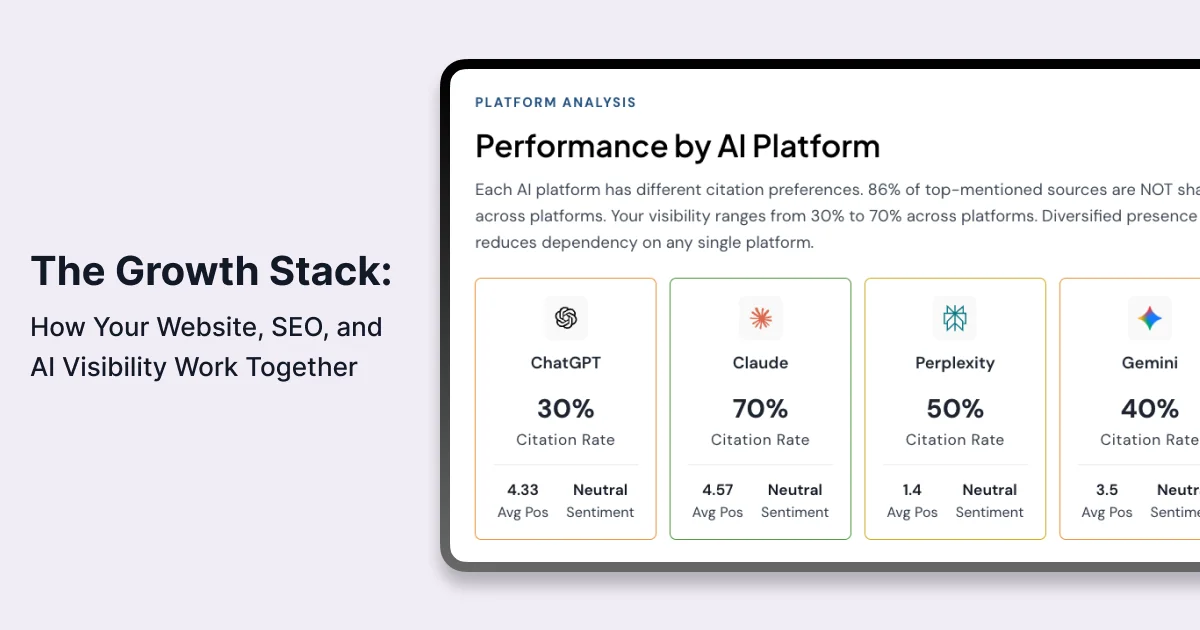
And here's a critical detail: 86% of the sources that AI platforms cite are unique to each platform (Ahrefs, 78.6 million interactions analyzed). Being visible on ChatGPT doesn't mean you're visible on Gemini or Perplexity. This is why AI visibility requires a multi-platform strategy, not a single-platform fix.
This is also where HireAWiz brings something to the table that most web design and SEO companies can't match. I built My Web Audit, the SaaS platform whose agency users have generated over 100,000 audits worldwide, including the AI Visibility Audit that evaluates a business's presence across all four major AI platforms. Our understanding of AI visibility doesn't come from reading about it. It comes from building the tools, analyzing the data, and seeing what actually moves the needle across thousands of audits.
Why the Order Matters (and Why Most Businesses Get It Wrong)
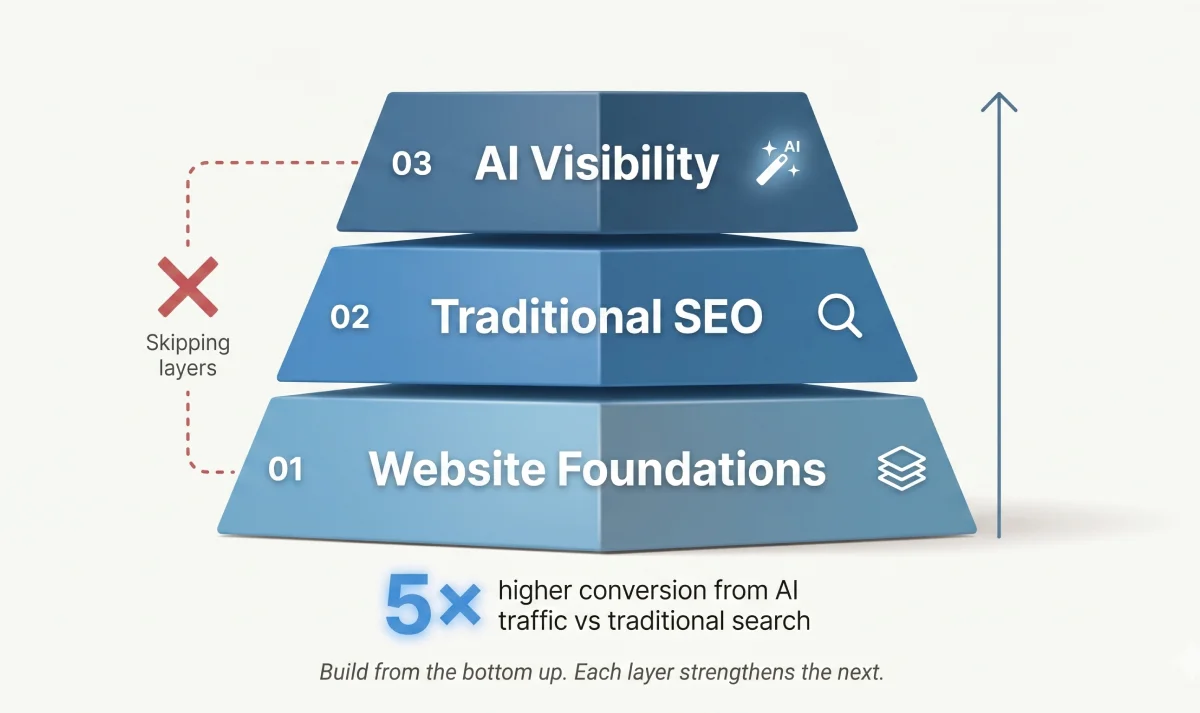
The most common mistake I see: businesses jumping to Layer 3 without addressing gaps in Layer 1 or Layer 2.
A company hears about AI visibility, gets excited, and wants to start optimizing for ChatGPT citations immediately. But their website loads in six seconds on mobile, their schema markup is nonexistent, and they haven't updated their Google Business Profile in two years. That's Layer 3 without Layer 1. The AI platforms can't crawl a slow site, can't understand an unstructured site, and can't trust a site with no authority signals.
The opposite mistake is just as common. A business invests heavily in SEO, earns strong Google rankings, and stops there. Their content is written for Google's algorithm but never structured for AI extraction. Their expertise is real but not documented in a way AI systems can evaluate. That's Layer 2 without Layer 3. They're leaving the fastest-growing search channel on the table.
The Growth Stack works because each layer strengthens the one above it:
Good website foundations make SEO more effective. A fast, well-structured site gives Google (and AI crawlers) exactly what they need to index and rank your content.
Good SEO builds the authority signals AI platforms rely on. Strong backlinks, consistent entity information, positive reviews, quality content — all of these feed directly into how AI systems decide who to recommend.
AI visibility expands your reach into a discovery channel that's growing faster than any other. And the traffic it sends converts at nearly five times the rate because these are people who received a direct recommendation, not people scrolling through a list of options.
How the Growth Stack Looks Across Different Businesses
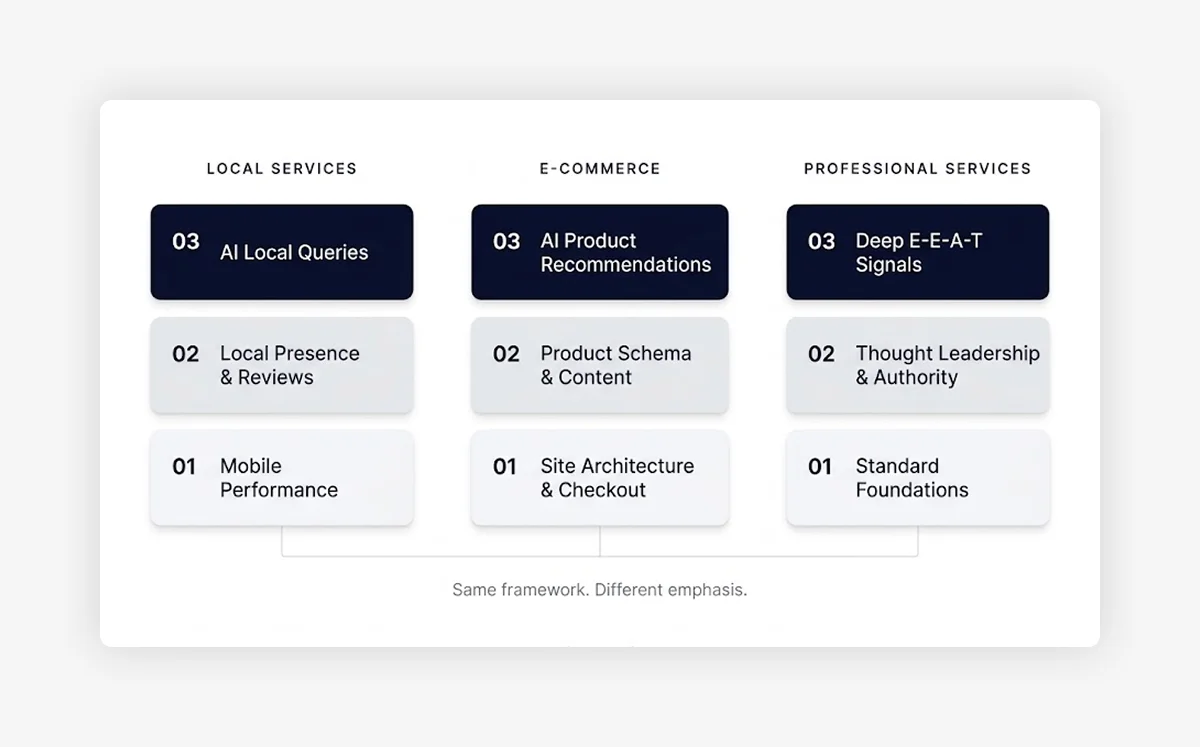
The framework stays the same, but the emphasis shifts depending on your industry and business model.
For local service businesses (home services, remodeling, Orlando-area contractors), the Growth Stack tilts heavily toward mobile performance and local presence. Most of these customers search from their phones, which means Layer 1 starts with mobile speed. Layer 2 prioritizes Google Business Profile, local citations, and review management. And Layer 3 targets the prompts that actually drive phone calls: "Who's the best roofer near me?" or "I need a reliable plumber in Orlando." In most local markets, very few businesses have optimized for these AI queries. That's a window.
E-commerce looks different. Site architecture, product page structure, and checkout performance dominate Layer 1. Layer 2 leans into product schema and comparison content. Layer 3 focuses on AI product recommendations and the "best of" queries shoppers are increasingly asking before buying.
For professional services and B2B, the emphasis shifts toward credibility and expertise. Thought leadership SEO, author authority, and deep E-E-A-T signals carry more weight here than in any other vertical.
Where to Start
This all makes sense in theory. But where do you actually start?
With an audit that evaluates all three layers.
HireAWiz's audit examines your website foundations, your SEO performance, and your AI visibility across ChatGPT, Gemini, Perplexity, and Claude. It shows where your foundation is solid, where your SEO is working, and where the AI visibility gaps are compared to your competitors. That data drives a prioritized action plan built on the Growth Stack, not a random list of disconnected tasks.
A realistic expectation: with the right work in the right order, businesses typically see 10 to 30% improvement in relevant traffic metrics within 90 days. By six months, with the content strategy in motion, that number moves to 30% or more. These aren't guarantees. They're the trajectory we build toward, and the Growth Stack is how we get there.
You don't need ten different strategies from ten different vendors. You need three layers, built in the right order, by a team that understands how they connect.
See where your business stands across all three layers of the Growth Stack.
Our free website audit evaluates your foundations, SEO performance, and AI visibility — and shows you exactly where to start.
Frequently Asked Questions
What is the Growth Stack approach to digital visibility?
The Growth Stack is HireAWiz's three-layer framework for building digital visibility. Layer 1 is Website Foundations (speed, security, structure). Layer 2 is Traditional SEO (Google rankings, local search, authority). Layer 3 is AI Visibility (getting cited by ChatGPT, Gemini, and other AI platforms). The layers build on each other from the bottom up.
Do I need to fix my website before investing in SEO or AI visibility?
Yes. If your website has significant speed, structure, or rendering issues, those problems undermine everything built on top of them. AI platforms can't cite content they can't crawl, and Google can't rank pages that load too slowly. Fixing the foundation first makes every dollar spent on SEO and AI visibility more effective.
How does traditional SEO relate to AI search visibility?
Traditional SEO builds the authority signals that AI platforms rely on when deciding who to recommend. Strong Google rankings, quality backlinks, consistent business information, positive reviews, and well-structured content all feed into how AI systems evaluate trustworthiness. SEO is the foundation that makes AI visibility possible.
What is AEO and how is it different from SEO?
AEO stands for Answer Engine Optimization. While SEO focuses on ranking in Google's search results, AEO focuses on getting your business cited and recommended when people ask AI platforms like ChatGPT or Perplexity direct questions. SEO optimizes for keyword rankings. AEO optimizes for AI citations and recommendations.
What is GEO (Generative Engine Optimization)?
GEO is the practice of optimizing your full digital presence so generative AI systems accurately represent and recommend your business. It includes content structuring for AI extraction, entity consistency, schema markup, authority building across platforms AI trusts, and monitoring how AI describes your brand.
Can a small or local business benefit from all three layers?
Absolutely. Local businesses often see the fastest results because AI visibility is still wide open in most local markets. When someone asks ChatGPT for "the best electrician in Orlando," very few local businesses have optimized for that query. Getting there first creates a meaningful competitive advantage while the space is uncrowded.
How long does it take to build the full Growth Stack?
The first 90 days focus on technical foundations and high-impact SEO fixes. Months three through six expand into content optimization and AI visibility work. Full momentum across all three layers typically develops within six to twelve months, depending on your starting point and competitive market. The Growth Stack is a system that compounds over time.

Related Articles
Business owners trying to get more visibility ask me one question more than any other. People just starting to learn…
A prospect named Marie asked me a sharp question last week. She works for a financial institution here in Florida,…
I gave a presentation last week to a company weighing whether to invest in SEO and AI search visibility. The…
Ready to Find Out Where You Stand?
No pitch. No pressure. Just a conversation about what's working, what's not, and where the opportunity is.
The AI Visibility Audit is free and shows you exactly how your business appears across ChatGPT, Perplexity, Claude, and Gemini before you invest a dollar.

5.0


