


An AEO audit (answer engine optimization audit) answers a question most business owners haven't thought to ask: when someone uses ChatGPT, Claude, Perplexity, or Gemini to find a business like yours, does your company show up?
A client we recently started working with sat across from us during an audit review, looked at the screen, and said: "So my competitor is showing up on ChatGPT for every search term I care about, and I'm not on there at all?" That reaction is more common than you'd expect. Business owners who have spent years building their reputation, earning referrals, and investing in their online presence discover that an entire search channel exists where they're invisible. Not ranking low. Not buried on page two. Invisible.
At HireAWiz, our AI Visibility Audit evaluates how Orlando businesses and national clients show up across all four major AI search platforms, using a methodology refined over 20,000+ hours of R&D and 100,000+ audits generated through My Web Audit, the SaaS platform our founder Cliff Almeida built. An AEO audit measures citation performance, technical foundations, trust signals, and content structure. The data it reveals goes far beyond a simple "visible or not" answer.
If you've searched for "AEO audit" to figure out what one actually evaluates, most of what you'll find are checklists and DIY frameworks. This is different. This is a walkthrough of what a professional AEO audit measures, section by section, and what those findings mean for your revenue.
Table of Contents
Why This Matters Right Now

The numbers tell the story.
ChatGPT now has 800 million weekly active users (OpenAI, October 2025). That number doubled in eight months. And 77% of those users treat ChatGPT as a search engine (Adobe, May 2025). They're asking it for recommendations, comparing businesses, and making decisions based on the answers they get.
Here's what makes this urgent for business owners: 87.4% of AI referral traffic comes from ChatGPT (Conductor, November 2025). When someone asks an AI platform for a recommendation in your industry and your business gets cited, those visitors convert at 4.4x the rate of traditional search traffic (Semrush, 2025). AI-referred traffic has grown 1,200% year-over-year (Adobe Analytics, 2025).
But context matters. Google still drives 345x more traffic than all AI platforms combined (Dataslayer, 2025). SEO is the foundation. AI visibility is the growth layer on top of it. An AEO audit evaluates both, because the two are connected. The same improvements that boost your AI visibility also strengthen your Google rankings.
The businesses positioning themselves now, while competition in this space is limited, are building authority that will be difficult to displace later. The ones waiting will have to fight harder for the same ground.
What Does an AEO Audit Measure?
At HireAWiz, we call ours the AI Visibility Audit. Here's what it covers, section by section, and what each finding reveals about your business.
1. Executive Summary and Scoring: Where You Stand at a Glance

The audit opens with an overall AI visibility score on a 0 to 100 scale, paired with a letter grade. It's designed to answer the first question every business owner asks: how am I doing?
The score combines two factors. Citation performance measures how often AI platforms actually recommend your business when tested with real prompts. Technical foundation measures whether AI platforms can properly discover, crawl, and trust your website. A strong technical foundation means nothing if AI platforms aren't citing you. Strong citations today can erode quickly if the technical foundation has gaps your competitors don't.
The executive summary also shows the citation gap between your business and your closest competitor, displayed as both a percentage and a multiplier. A 25-point gap in either direction tells a clear story. You don't need a technical explanation to understand it.
The top three improvement opportunities are listed here too. They set the agenda for everything that follows.
2. Platform-by-Platform Visibility: Four Platforms, Different Stories
This is where most business owners get their first surprise.
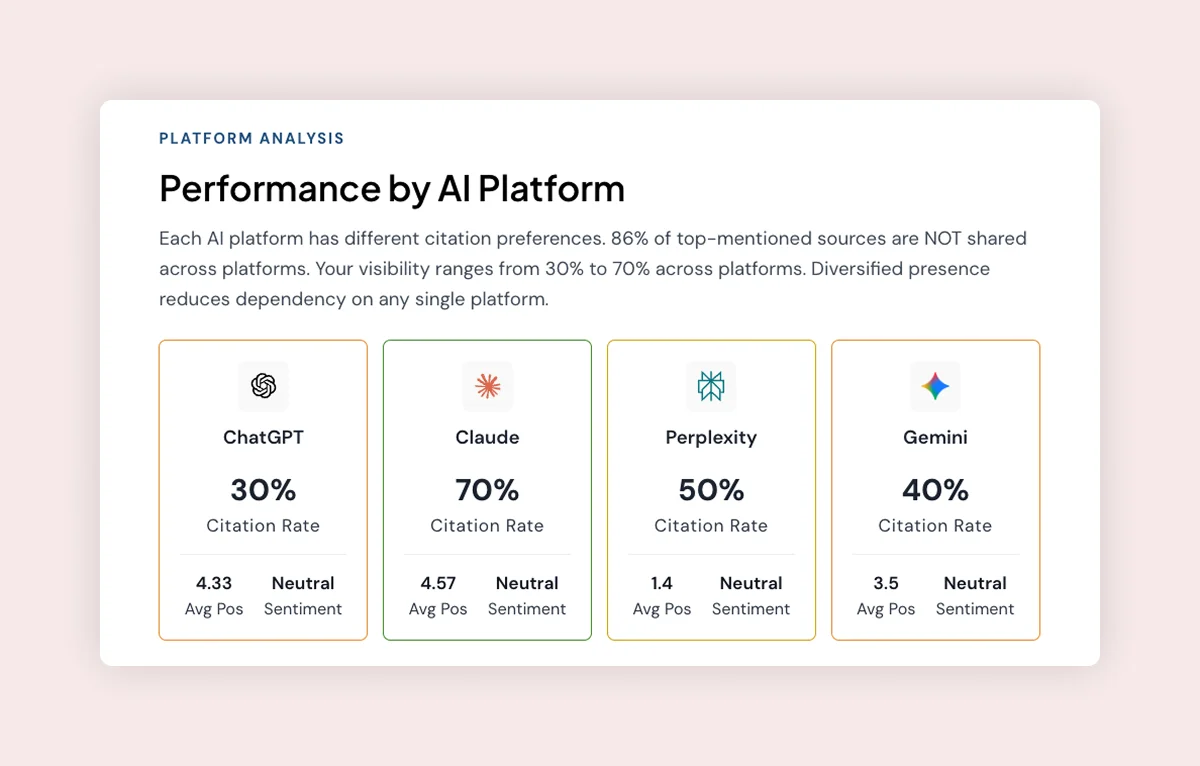
Research from Ahrefs analyzing 78.6 million interactions found that 86% of top-mentioned sources are unique to a single platform. What that means in practice: your business can perform well on Claude and be completely invisible on ChatGPT, where the vast majority of AI referral traffic originates.
The audit tests visibility across ChatGPT, Claude, Perplexity, and Gemini individually. For each platform, you see your citation rate, average position, and sentiment, displayed side by side for comparison.
Each platform has different citation preferences. They weigh different signals, pull from different source pools, and evaluate content differently. A business scoring 80% on one platform and 10% on another is not unusual. It's the norm. The platform-by-platform view makes the data actionable. If ChatGPT is weak but Perplexity is strong, you know where to focus first and why.
3. Sentiment Analysis: How AI Describes You

Showing up in AI results matters. Showing up with the wrong tone can backfire.
The audit tracks whether AI platforms use endorsement language, neutral listing, or cautionary language when mentioning your business. A citation paired with negative sentiment can hurt more than no citation at all. If ChatGPT recommends your competitor with enthusiasm and mentions your business with caveats, that shapes how prospects perceive you before they ever visit your website.
This is a layer most people never think to check.
4. Citation Testing with Real Prompts: The "Aha" Moment

This is the section where AI visibility stops being abstract and becomes measurable. It answers the question every business owner has: "When someone asks ChatGPT for my service in my city, what happens?"
The audit tests a matrix of industry-specific prompts across all four AI platforms. For each prompt, you see the citation position (1st through 6th, or not cited) on every platform. These results come from live searches, not cached data. AI platforms update their responses frequently, so the audit captures a real-time snapshot.
Different prompt types test different stages of the buyer journey:
Local queries test whether your business appears in location-specific searches. For an Orlando remodeling company, that might be "best kitchen remodeler in Orlando" or "licensed general contractor Central Florida."
Discovery queries test how you appear when someone is exploring options. "How to choose a roofing contractor" or "what to look for in a web design company."
Comparison queries test whether you're mentioned as buyers narrow their choices. "Local vs. national marketing agency" or "independent contractor vs. franchise."
Problem-based queries test whether you show up when someone describes a challenge. "Website not showing up on Google" or "foundation cracks in Florida homes."
FAQ queries test whether AI cites your content when answering common industry questions.
When you pull up the citation matrix and see your competitor appearing across three platforms while your business is absent, the data speaks for itself. No sales pitch required.
Citation position matters too. Being recommended first in an AI response carries significantly more weight than being mentioned sixth. The first few positions get the click. The sixth position may not even be read.
Curious where your business shows up?
Get your free website audit and we'll show you exactly how you appear across ChatGPT, Claude, Perplexity, and Gemini.
5. E-E-A-T Signals: The Trust Layer AI Uses to Decide Who Gets Recommended

E-E-A-T stands for Experience, Expertise, Authoritativeness, and Trustworthiness. Google has used these signals for years. AI platforms weigh them even more heavily when deciding who to cite.
Here's what we see in almost every audit: most businesses have credentials, results, and experience worth showcasing. They just haven't organized them in a way AI systems can see.
The audit evaluates whether your website communicates these signals effectively. Do your content pages have author attribution with real credentials? Are your case studies and testimonials published on web pages where AI crawlers can access them, or locked behind PDFs and forms? Do you have structured data that tells AI platforms who you are, what you do, and where you operate?
A pest control company that says "we provide excellent service" gives AI nothing to work with. A pest control company that says "after treating 2,300 homes in the metro area over the past decade, here's what we've learned about scorpion behavior in newer construction" gives AI something concrete to reference and cite.
Most businesses fall short here. Not because they lack the credentials, but because they haven't made them visible to the systems that now decide who gets recommended.
6. Technical Visibility Scorecard: Can AI Even Find Your Content?

Strong content on a technically broken site won't get cited. This is true for Google, and it's true for AI platforms. The difference is that AI crawlers are often less forgiving. They're looking for structured, accessible content they can parse quickly.
The audit checks nine technical elements: Schema Markup, AI Crawler Access, Core Web Vitals, HTTPS and Security, E-E-A-T Signals, JavaScript Rendering, llms.txt File, XML Sitemap, and Semantic HTML Structure. Each gets a pass, needs work, or fail assessment with an impact rating.
Two elements carry the most weight. Schema markup tells AI platforms what your business is, what it does, and where it operates, all in structured data they can parse in seconds. AI crawler access determines whether platforms like ChatGPT, Claude, and Perplexity can read your site at all. If your robots.txt file blocks AI crawlers, nothing else in the optimization conversation matters until that's fixed.
You don't need to understand how these work at a code level. What matters is that an AEO audit checks for them and identifies what needs fixing. Think of it as the plumbing inspection. If the plumbing is broken, the kitchen renovation doesn't matter.
One technical element worth mentioning specifically: IndexNow. It's a protocol that notifies Bing immediately when content is updated, and since ChatGPT relies on Bing's index, it's one of the fastest ways to get fresh content in front of the platform that drives 87.4% of AI referral traffic. Simple to implement, ongoing benefit.
7. Content and Page-Level Analysis: Are Your Key Pages Built for AI Extraction?

This section gets specific. Each priority page gets a content depth assessment: current word count versus recommended target, specific sections to add, and schema markup recommendations.
A 400-word service page with no schema is easy for AI to overlook. A 1,500-word page with proper schema, author attribution, and deep topical coverage is much harder to skip. The audit spells out that gap for each key page. Specific targets with specific additions, not a vague "improve your content" note.
The audit also highlights quick wins. Maybe a service page is ranking on page two for a valuable term and just needs 300 more words and proper schema. Maybe a blog post is being cited on Perplexity but not on ChatGPT, and adding author credentials could close that gap. These are low-effort, high-impact opportunities that justify immediate action.
Content freshness matters more than most businesses realize. Research from AirOps found that 95% of ChatGPT citations come from content published or updated within the last 10 months, and pages with a visible "last updated" date receive significantly more citations than those without one. If your most important pages haven't been touched in a year, AI platforms are likely favoring competitors with newer content.
From AEO Audit to Action Plan

An AEO audit doesn't just show gaps. It prioritizes what to fix first.
At HireAWiz, we follow a structured approach we call the Growth Stack: Website Foundations first, then Traditional SEO, then AI Visibility. The reason is practical. Technical quick wins like fixing crawler access, implementing schema markup, and improving page speed create the foundation that makes everything else work harder. Content optimization builds on that foundation. Authority building and AI-specific strategies come next.
This sequence means you're not throwing money at AI visibility while your website's technical foundation leaks value. Every improvement compounds across both Google and AI platforms. One investment, two channels.
The audit identifies which fixes produce the fastest results and which require sustained effort. For most businesses, the first 30 days focus on technical foundations. Days 30 through 60 shift to content optimization. Days 60 through 90 move into authority building and active pursuit of AI citations. Quick wins in the first phase often show measurable change within weeks. Meaningful traffic growth typically takes three to six months, depending on competition and starting position.
Why HireAWiz Runs This Audit Differently
There are plenty of tools that check a few boxes and call it an AEO audit. What sets our approach apart is the depth behind it.
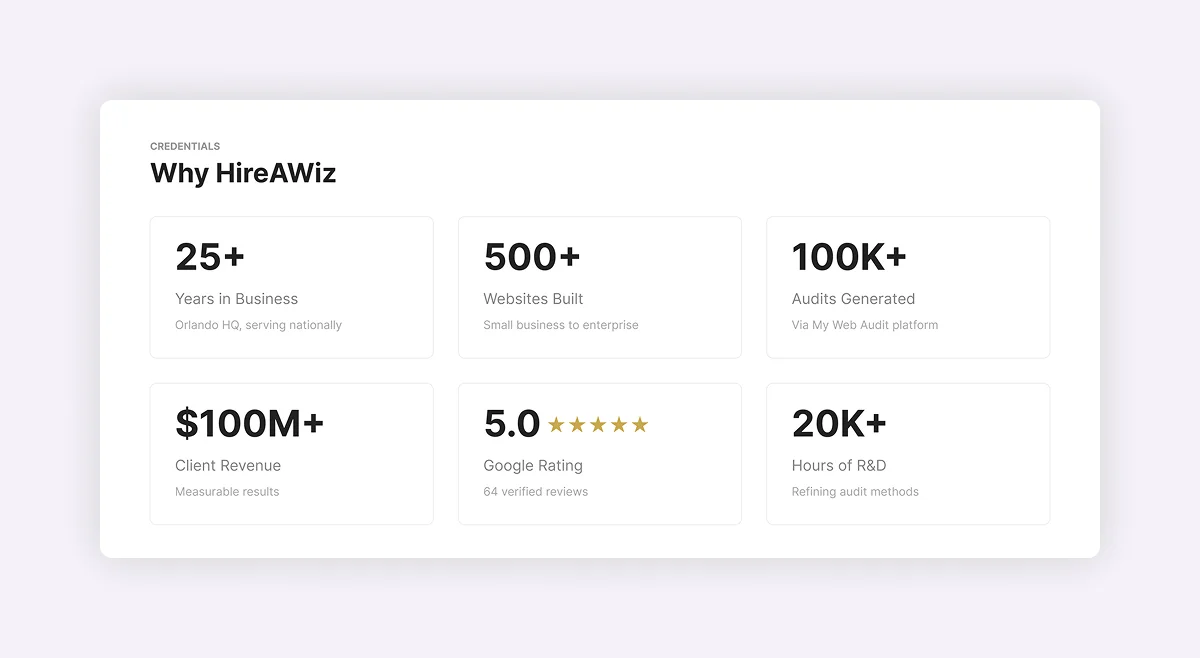
Cliff Almeida, our founder, built My Web Audit from the ground up. It's a SaaS platform that hundreds of agencies worldwide rely on to deliver web design audits, SEO audits, and AI visibility audits to their own clients. Over 100,000 audits generated. Over 20,000 hours of R&D invested in building and refining audit methodologies. That depth of experience doesn't just inform the tool. It informs how we interpret the data, prioritize findings, and build the roadmap for each business we work with.
We've been in this business for over 25 years, now headquartered in Orlando and serving clients nationally. 500+ websites built. $100M+ in client revenue generated. Enterprise clients including Cox Communications, General Dynamics, National PTA, and the U.S. Attorney's Office. A 5.0 Google rating across 64 reviews. When we walk a business owner through their AEO audit findings, we're not reading from a script. We're interpreting data through decades of experience building websites and search strategies that produce measurable results.
Todd Whittaker Drywall is one example. After working with us, they saw a 600% increase in traffic and now generate over $1M in annual revenue from their online presence. That kind of outcome comes from a process that starts with thorough evaluation and leads to focused execution.
Our methodology is so refined it became a product other professionals rely on. That's the difference between a company that runs reports and a company that built the system the reports are based on.
Get Your Free Website Audit
If you've read this far, you already know whether this matters for your business. The next step is seeing your own data.
Our free website audit evaluates your site and shows you where the opportunities are, across both traditional search and AI platforms. No jargon. No pressure. Just a clear picture of where you stand and what it would take to improve.

Get Your Free Website Audit.
We'll evaluate your site across both traditional search and AI platforms. No jargon. No pressure. Just a clear picture of where you stand.
Frequently Asked Questions
What does AEO stand for?
AEO stands for Answer Engine Optimization. It refers to the practice of optimizing your business's online presence so AI platforms like ChatGPT, Claude, Perplexity, and Gemini can find, understand, and recommend your business when potential customers ask for help in your industry. An AEO audit evaluates how well your business is positioned across these platforms.
What does an AEO audit measure?
An AEO audit measures how your business appears across AI search platforms like ChatGPT, Claude, Perplexity, and Gemini. It evaluates citation performance (how often you're recommended), technical foundations (whether AI can find and read your site), E-E-A-T signals (trust and authority indicators), and content structure (whether key pages are built for AI extraction).
How is an AEO audit different from a traditional SEO audit?
A traditional SEO audit focuses on Google rankings, keyword positions, and technical health for search engines. An AEO audit tests actual AI platforms with real prompts, measures citation rates across multiple platforms, evaluates sentiment, and assesses trust signals that AI systems weigh differently than Google. The two audits are complementary because the improvements overlap.
How often should AI visibility be re-evaluated?
AI platforms update their models and citation preferences frequently. We recommend a full re-evaluation every 90 days, with ongoing monitoring in between. Quarterly benchmarking catches shifts in competitive positioning and platform behavior before they become problems.
What if my business isn't showing up on any AI platform?
That's the starting point for most businesses. Roughly 87% of businesses have no meaningful presence in AI search results. The audit identifies exactly why you're not showing up and prioritizes the fixes that will change that, starting with technical foundations and building toward content and authority.
How does AI visibility relate to my existing SEO investment?
Everything that improves AI visibility also strengthens Google rankings. Schema markup, content depth, author attribution, page speed, and E-E-A-T signals are valued by both. AI visibility optimization is an extension of your SEO strategy, not a replacement for it. One investment improves performance across both channels.
How long does it take to see results after an AEO audit?
Technical quick wins like fixing AI crawler access and implementing schema markup can show impact within 30 to 60 days. Content optimization and authority building produce meaningful results in three to six months. The audit prioritizes what to tackle first so you see the fastest possible return on your investment.

Related Articles
Most SEO guides feel like they were written for everyone, which means they were written for no one. This one…
SEO Isn't Dead. But It's Not Enough Anymore: Why AI Visibility Is the Next Layer Your Business Needs
Last year, one of our clients typed their most important service into ChatGPT. Their top competitor came up. They didn’t….
Everyone selling digital marketing has a different answer to the same question: “What does my business actually need?” One vendor…
Ready to Find Out Where You Stand?
No pitch. No pressure. Just a conversation about what's working, what's not, and where the opportunity is.
The AI Visibility Audit is free and shows you exactly how your business appears across ChatGPT, Perplexity, Claude, and Gemini before you invest a dollar.

5.0


