
Build, Hire, or Partner: The AI Search Decision Every Business Owner Is About to Face

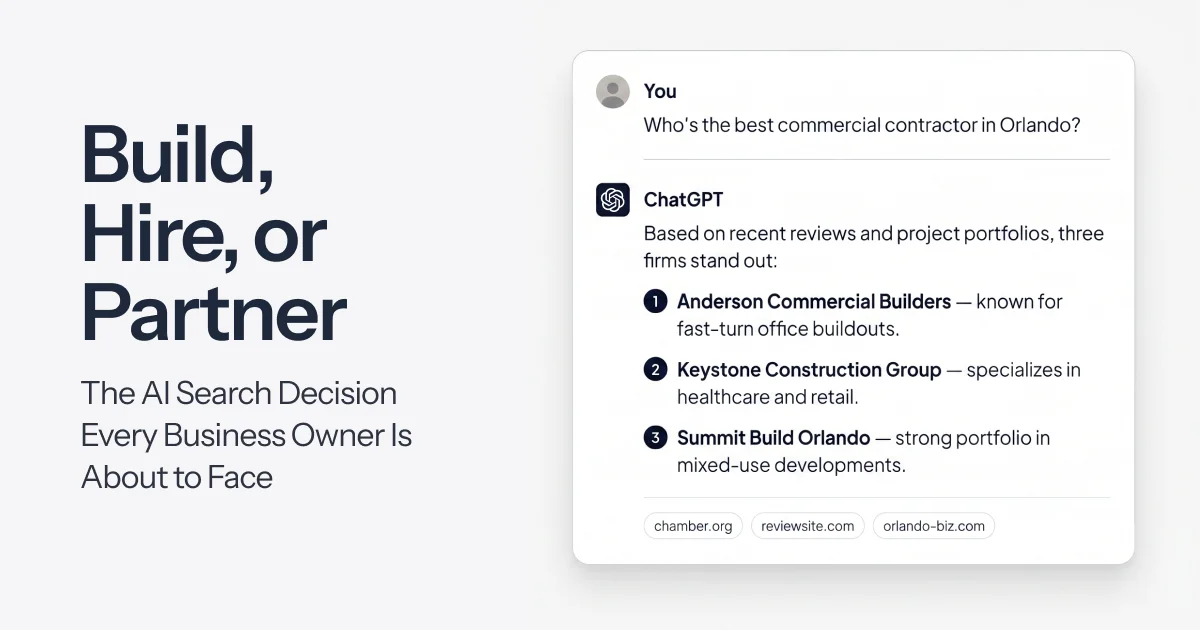
A potential customer in your market just asked ChatGPT or Claude to recommend the best company for the service you sell. Three businesses got named. Yours wasn't one of them.
That's not hypothetical. It's happening thousands of times a day. Businesses that look a lot like yours are being passed over, and most owners don't find out until a competitor they respect starts winning deals they used to close.
The shift is real. It's measurable. It's moving faster than most industries want to admit. If your business depends on being found, the next few months will shape your revenue for the next three to five years.
The proof that this shift is real and accelerating shows up in the hiring market.
In the past few months, at least eight media agencies have opened senior AI search roles, with most salaries landing between $100,000 and $150,000 and at least one managing director position posted at $260,000. Brainlabs recently added ten staffers to a team that already numbered 120. Tinuiti, Kepler, Critical Mass, and numerous other agencies are all shopping for the same kind of expertise at the same time.
Meanwhile, brands like Pfizer are pulling this work in-house. AI search has moved from interesting to strategic fast enough that enterprise brands want the capability living inside their building.
If you run a business in the $2M to $50M range, you just inherited a decision you didn't have two years ago. You can build this capability in-house. You can hire one of the big agencies still staffing up. You can partner with a specialist company like our that already has it built. Most owners are quietly defaulting to "we'll figure it out later," which is also a decision, and it's the one that will cost the most in 18 months.
The short version:
- Path 1 (build in-house): Makes sense for enterprise budgets and full-time workloads. For most $2M to $50M businesses, the math doesn't work.
- Path 2 (hire a large agency): Makes sense if you value a named brand on your vendor list and accept junior execution on your account.
- Path 3 (partner with a specialist company like ours): The right fit for most mid-market businesses that want senior expertise, direct accountability, and integrated work across web, SEO, and AI visibility.
- Avoid this: The $800 to $1,200 per month providers promising first-page rankings and AI visibility. The math doesn't support real results, and the hidden cost is 12 to 24 months of lost ground.
The full reasoning, cost math, and decision framework are below.
Why this decision exists now
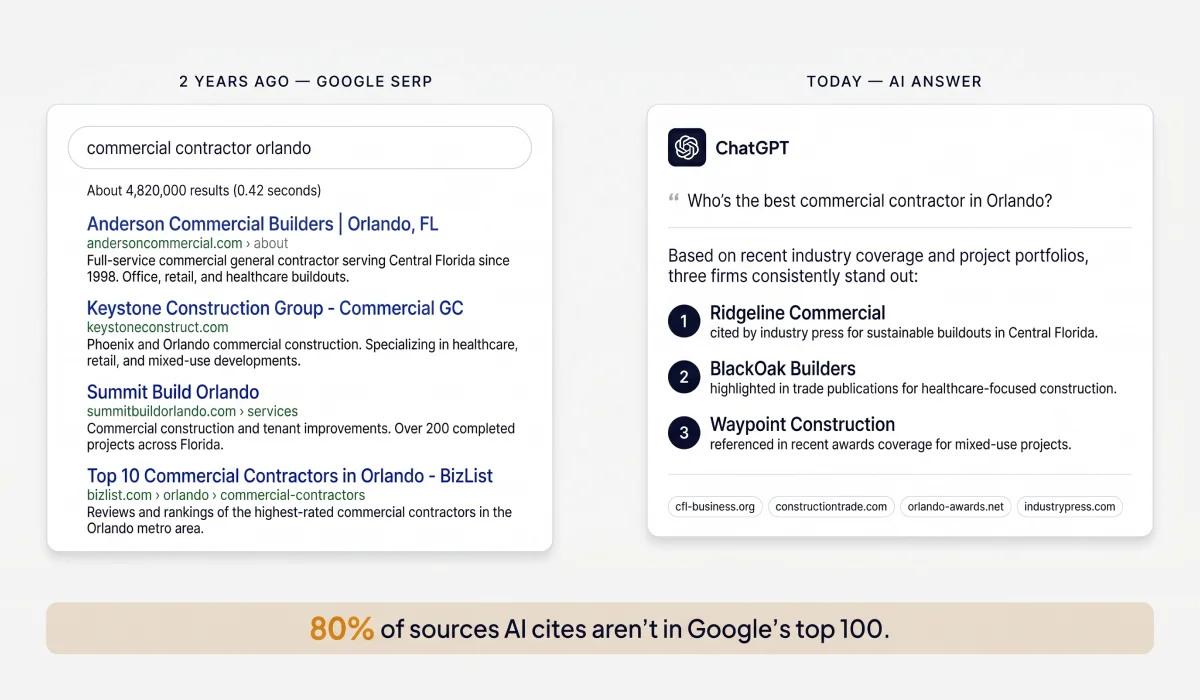
Two years ago, search was primarily Google. You ranked, or you didn't. The work had a clear shape, and most established companies had a vendor relationship that covered it.
That world is fracturing.
ChatGPT grew from 400 million weekly users in February 2025 to more than 900 million by February 2026, per OpenAI's own disclosure, and 77% of the Americans who use it now treat it as a search engine. Google now runs AI Overviews on close to half of all searches, based on BrightEdge's twelve-month tracking data, pushing the traditional blue links further down the page. Perplexity, Gemini, Claude, and other platforms are growing in parallel. When a prospect asks an AI assistant "who's the best commercial contractor in Orlando," the answer comes from a different algorithm than the one deciding your Google ranking.
Here's the part most owners miss: 80% of the sources AI platforms cite aren't in Google's top 100 results, according to an August 2025 Ahrefs study. A company can sit on page one of Google for its core keywords and still be invisible the moment a prospect switches to ChatGPT. SEO isn't dead, but it's no longer enough on its own. Separate skill, separate workflow, separate measurement.
The work has a name now. Answer Engine Optimization (AEO) refers to the practice of making content that AI assistants like ChatGPT and Perplexity can extract and cite. Generative Engine Optimization (GEO) covers how brands get surfaced in AI-generated responses across platforms. Together, they make up the zero-click future of search that Google's AI Overviews have already ushered in. The terms matter because they map to distinct tactical work.
This is why the agency world is hiring fast. This is why Pfizer built an internal team. This is why the decision can't stay on the back burner. Every month a business waits, a competitor is building entity authority that gets harder to displace later. The businesses that establish visibility in AI search this year will own that channel for years. The ones that don't will be left wondering why their phone stopped ringing even though their Google rankings look fine.
The cost of being invisible in AI search is typically $80,000 to $200,000 per year for mid-market businesses. Run the math on your own business for a moment. Let's be conservative, and assume that if two good-fit customers a year go to a competitor showing up in AI search while you don't, and each one is worth $20,000 to $40,000 in lifetime value, that's $40,000 to $80,000 in lost revenue annually.
These aren't deals you lost in a fair fight. They're deals you were never in the conversation for, because the prospect asked ChatGPT, got three names, and called one of them. Most owners never see these losses in a report because they don't show up anywhere. The pipeline just quietly diminishes over time.
Path 1: Build an in-house team
Start with where it fits.
Building in-house makes sense when the workload is genuinely full-time, the budget supports senior-level compensation, and the business has enough existing marketing infrastructure to plug a new team into. Large enterprises with dozens of product lines, multi-market campaigns, and a bench of supporting roles can absorb the investment and keep the team fully utilized.
The real cost is higher than most owners assume.
A senior director with legitimate AI search expertise runs $150,000 to $260,000 in base salary, based on the roles currently being advertised. Add 30 to 40% for benefits and overhead. Then factor in the reality that a director alone can't do the work. You'll need technical SEO support, content production, data and reporting, and usually at least two or three additional hires before the team is actually productive. Tooling adds another $30,000 to $100,000 annually for enterprise-grade AI visibility platforms, SEO software, and analytics infrastructure.
That's before you've produced anything.
There's also a ramp problem. A new team takes 3 to 4+ months before it's producing reliably. Knowledge concentrates in one or two senior people, and when an agency makes them a competing offer (which is exactly what's happening right now, per the Digiday hiring data), the institutional knowledge walks out the door with them.
For a business in the $2M to $50M range, the math rarely works. You're paying large company salaries for someone who may be underutilized half the time, or you're underpaying for the seniority you actually need. The in-house path is real, but it's almost always the wrong answer for mid-market companies.
Path 2: Hire a large agency
The big agencies are hiring because client demand is surging. That's a signal worth reading carefully.
Where a holding-company agency fits: enterprise accounts where the agency assigns dedicated senior leadership, global campaigns that need multi-market scale, and businesses that value having a named brand on the vendor list for internal credibility reasons.
What you actually get is more nuanced than the pitch deck suggests.
- You get a deep bench of expertise somewhere in the building.
- You get sophisticated tooling.
- You get polished reporting.
- You also get junior execution on your account.
Senior strategy shows up in the pitch meeting and then rotates to the next new business opportunity. Day-to-day contact is often an account manager two years out of school. The VP whose LinkedIn headline sold you on the agency may touch your account for 30 minutes a month, if that.
Sometimes less.
Minimum engagements typically start at $10,000 to $25,000+ per month. Reporting is professionally designed and frequently disconnected from actual revenue outcomes. You're one of hundreds of accounts, and your priority inside the agency is a function of your billing size.
The hiring pattern itself tells the story. Eight agencies staffing up this aggressively means they don't have the capacity today. A new hire's first few accounts are where their learning curve plays out. When Wpromote's VP tells Digiday that every single client is asking about AI discoverability, that's not a description of settled expertise. That's a market learning in public, with client budgets funding the education.
For the right-sized enterprise, a holding-company agency is a reasonable answer. For most mid-market businesses, it's an expensive way to get junior work.
It's sad but over the years, companies have come to us after hiring some of these larger agencies because they were overwhelmed by reports and strategy but saw little in the way of results which to them is more visibility, traffic, leads and revenue.
Many found themselves buried under complex analytics and lengthy proposals, yet were left wanting more when it came to actionable outcomes and real impact on their goals. This is where we step in, offering clear solutions and dedicated support to drive meaningful results.
The cheap provider trap: Why $1,000 per month agencies fail mid-market businesses
Most businesses take a fourth option by default: hire whoever shows up in their inbox with a low cost monthly retainer around $1000 promising first-page Google rankings and AI visibility.
This option has the highest failure rate of any path on the table.
The math makes real results impossible. AI visibility work requires senior strategy, technical implementation, content production, schema engineering, authority building, and ongoing monitoring. A $1,000 monthly retainer buys roughly 5 to 8 hours of junior work, nowhere near enough to move the needle on a business over $2M in revenue. What you actually get is a dashboard with movement, a monthly report, and no meaningful change to leads or revenue.
The $12,000 a year isn't what makes this expensive. The expense is the 12 to 24 months you wasted believing the work was getting done while competitors invested in real capability and moved ahead. Opportunity cost compounds in the wrong direction.
This isn't hypothetical. Several clients have come to HireAWiz after trying this route first. Their rankings took a hit. Their backlink profiles got polluted with low-quality links. The technical foundation needed rebuilding before any real work could move the needle. HireAWiz resolved those situations, but the recovery cost each client more money, more months of lost visibility, and more frustration than if they had invested in real work from the start.
If the budget isn't there for a real investment yet, holding the money beats spending it on work that won't produce anything.
Three objections worth addressing directly
Three reservations most business owners are holding in their head right about now.
"My referrals, sales team, and conferences already bring in business. Why do I care about AI search?"
Existing channels aren't going away, and AI search isn't replacing them. It's an additional channel where prospects are actively looking for solutions right now. If your business isn't showing up, those leads go to the competitor who is.
The competitive advantage sits in timing. Google search and paid advertising became expensive channels because everyone figured them out, and early movers built cost efficiency that latecomers are still chasing. AI search is at the opposite end of that curve today. Businesses establishing visibility now will lock in position before the channel gets saturated. Waiting until it's crowded means paying more for less.
Referrals fill the top of the funnel. Sales teams close deals. Conferences generate qualified meetings. AI search adds a lead source your competitors haven't figured out yet, and every month it stays unclaimed is a month of free compounding for the businesses that move first.
"Can I just wait another year and see how this plays out?"
You can, but the cost isn't neutral. Entity authority in AI search is cumulative. The businesses that establish content depth, schema, and third-party citations this year will be the defaults AI platforms recommend next year. Businesses that wait will find themselves competing against entrenched citations instead of stepping into open space. Another quarter of deferral is another quarter of compounding disadvantage.
"Will AI search even matter in two years, or is this a fad?"
ChatGPT just crossed 900 million weekly users. Google is integrating AI into 48% of its search results. Microsoft, Apple, Meta, and every major enterprise software company is racing to embed AI assistants into their products. Given the scale and speed, the only remaining question is when to get started, the only answer for businesses who want to compete and grow online is now.
Path 3: Partner with a specialist company
The third path is the one most business owners don't realize exists as a category. It's not a freelancer, and it's not a 500-person holding-company shop. It's a specialist company where senior people are actually doing the work on your account.
Where it fits: businesses investing $25,000 to $250,000 annually across web, SEO, and AI visibility, owners who value direct accountability over name recognition, and companies that want web design, traditional SEO, and AI visibility running as one integrated system rather than three disconnected vendor relationships.
HireAWiz was built for this role.
Speed to results is the second differentiator. Most companies selling web, SEO, and AI visibility work ask clients for 6 to 12 months before results start to show. HireAWiz aims to deliver ROI inside 90 days, and sometimes inside 30 for businesses with existing opportunities that haven't been capitalized on yet. That's possible because Cliff Almeida and the HireAWiz team have refined the methodology across 500+ client websites over 24 years. Quick wins get found first. Compounding gains come next.
Cliff Almeida founded HireAWiz in 2001 and has led the company for 24+ years from its Orlando, Florida headquarters. Over 25 years in web design, SEO, and digital marketing, he's led projects that generated more than $100M in client revenue, with consulting and partner work touching Cox Communications, General Dynamics, the U.S. Attorney's Office, the Arizona Governor's Office, and the National PTA. The UpCity Local Excellence Award recognized the company in both 2022 and 2023. The money-back guarantee that's been in place since day one has never been paid out.
The AI visibility expertise isn't recent. Cliff built My Web Audit, the SaaS platform used by hundreds of agencies worldwide to run website, SEO, Google Business Profile, and AI visibility audits. The platform has generated more than 100,000 audits for its agency customers. When the Digiday article describes agencies hiring $260,000 directors to build AI visibility capability, some of those same agencies are running audits through a platform Cliff built.
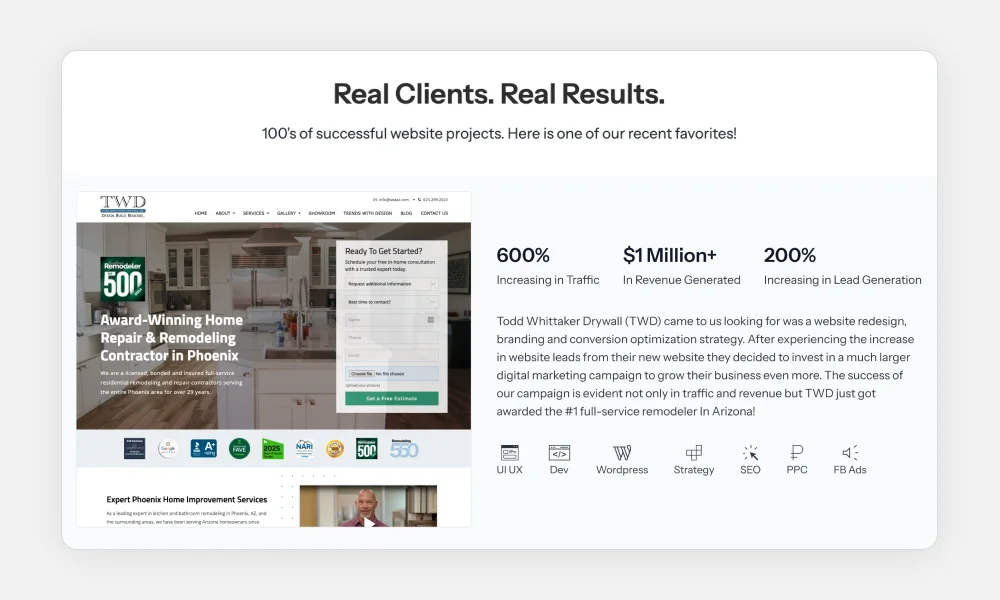
The outcome that matters most lives with a client who's been with HireAWiz for more than a decade. Todd Whittaker Drywall came to HireAWiz ranked as a Top 500 home remodeling company. Ten years later, they're in the Top 100. Along the way, their organic traffic grew 600%, their leads grew 200%, and their digital revenue now exceeds $1M annually. Their phone rings today because of integrated work across web, SEO, and AI visibility that they invested in years ago and never stopped compounding.
If this is starting to sound like the fit your business is missing, a free AI Visibility Audit is the fastest way to see where you stand today. No pitch, no commitment.
The through-line: while the rest of the industry is competing to hire AI search expertise, HireAWiz has been building AI visibility capability since before most agencies knew it was a category.
The decision framework
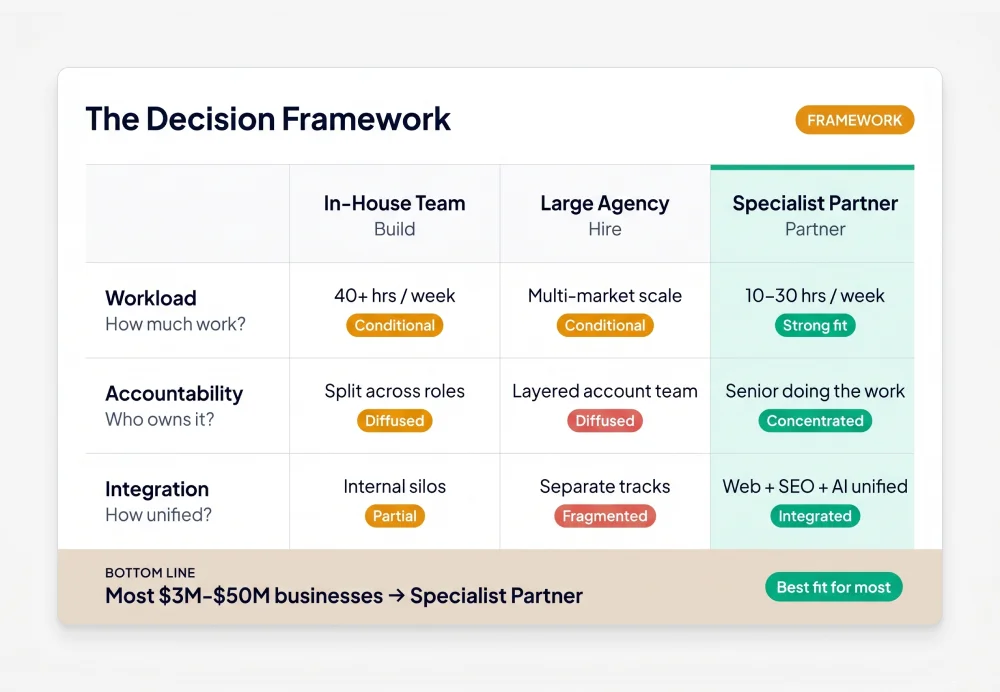
Three questions will point you to the right path. Read them as parallel prompts, not as a checklist.
Question 1: How much work is there, really?
If your business needs 40+ hours a week of focused search work across multiple domains, geographies, or product lines, in-house can justify the investment. If the work sits in the 10 to 30 hours a week range and needs integrated strategy across web, SEO, and AI visibility, a specialist partner is the right shape. If the work is genuinely intermittent, retainer models outperform any in-house build.
Question 2: Who needs to own the accountability?
In-house puts accountability inside the building and splits it across multiple roles, which makes ownership harder, not easier, when something goes wrong. Large agencies own accountability on paper and diffuse it across account teams in practice. Specialist companies typically concentrate accountability in the senior people doing the work, which is the model that makes "one throat to choke" a real thing instead of a tagline.
Question 3: How integrated does the work need to be?
If web design, traditional SEO, and AI visibility are going to run as separate tracks, multiple specialized vendors can coexist. If they need to reinforce each other, and in most businesses they should, then an integrated partner is the faster path to compounding results. AI platforms cite sites that are technically sound, traditionally authoritative, and semantically structured. Splitting that work across disconnected vendors slows every layer of it down.
The bottom-line answers
For most $3M to $50M businesses, the right choice is to partner with a specialist company. For enterprise brands with 40+ hours of weekly search work and existing marketing infrastructure, building in-house or engaging a holding-company agency can make sense. For businesses with budgets under $25,000 annually, the best move is to wait until the budget can support real work rather than hire a cheap provider that will damage your foundation.
What to do next
The businesses that solve AI search in 2026 will have one thing in common. They stopped treating it as a future problem.
For most of the businesses reading this, Path 3 is the answer. If you've landed somewhere else after running the framework, that's fine too. The worst answer is another quarter of deferral.
If Path 3 is where you are, HireAWiz, based in Orlando, Florida, offers a free AI Visibility Audit that shows you where your business stands today. You'll see which AI platforms cite you, which ones cite your competitors, what specific gaps are keeping you invisible, and what it would take to close them. It's the same audit methodology that powers My Web Audit, the platform hundreds of agencies use to do this work for their own clients.
The audit itself is free. HireAWiz also stands behind its design work with a money-back guarantee that's been in place since 2001 and has never been paid out.
Request your free AI Visibility Audit or schedule a consultation.

Related Articles
Business owners trying to get more visibility ask me one question more than any other. People just starting to learn…
A prospect named Marie asked me a sharp question last week. She works for a financial institution here in Florida,…
I gave a presentation last week to a company weighing whether to invest in SEO and AI search visibility. The…
Ready to Find Out Where You Stand?
No pitch. No pressure. Just a conversation about what's working, what's not, and where the opportunity is.
The AI Visibility Audit is free and shows you exactly how your business appears across ChatGPT, Perplexity, Claude, and Gemini before you invest a dollar.

5.0


