
AI Search and Geolocation: What Local Businesses Need to Know

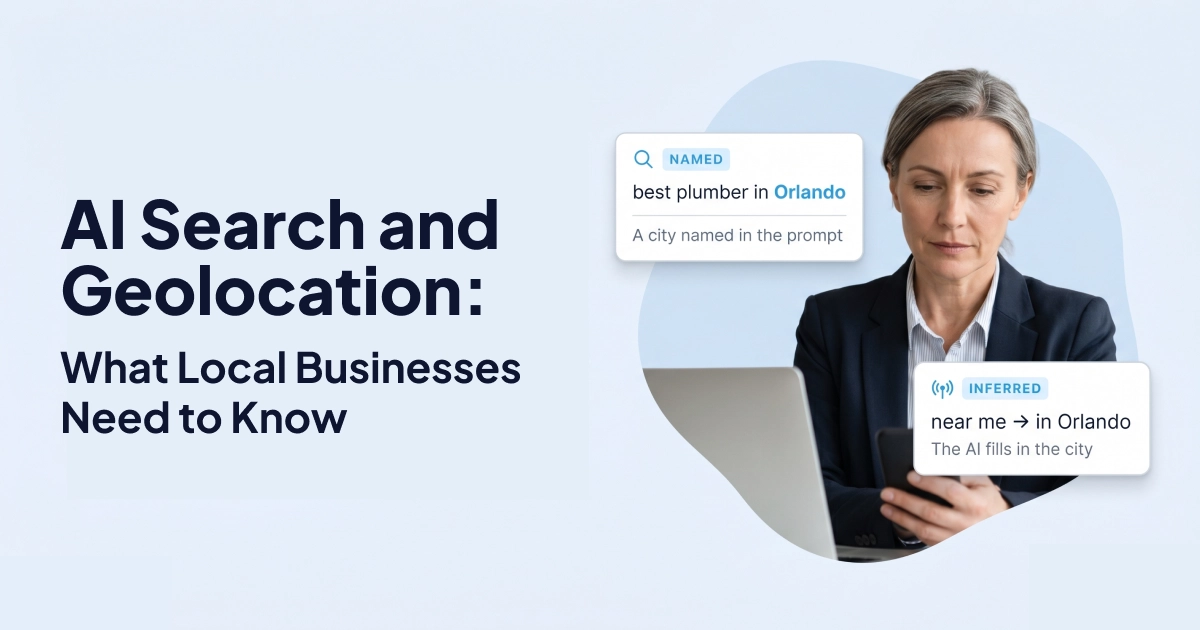
A prospect named Marie asked me a sharp question last week. She works for a financial institution here in Florida, and she wanted to know two things. When someone asks ChatGPT or Google for a recommendation, does naming a city in the question change the answer? And can these AI tools figure out where a person is sitting without being told?
Fair questions. Both have answers grounded in what the platforms themselves publish, not guesswork. And both have direct consequences for whether your business shows up when a nearby customer asks an AI assistant who to call.
Let me walk through what the data says, then what it means for you.
The short version
Naming a location in a prompt is one of the strongest signals you can send an AI search tool. The more specific the location, the more confident the AI gets about local intent, and the more likely it is to surface nearby businesses instead of national brands.
AI platforms can also estimate a person's location without being told, and they do it in different ways. ChatGPT works from an approximate, IP-based guess at your city or region. Google leans on your actual device location and can get far more precise. Either way, this is documented behavior, not theory, and it shapes which businesses surface for a local question.
The practical conclusion: you want to be visible whether the customer names your city or not. That means two things working together, and I'll get to both.
Does naming a location in the prompt matter?
Yes. Significantly.
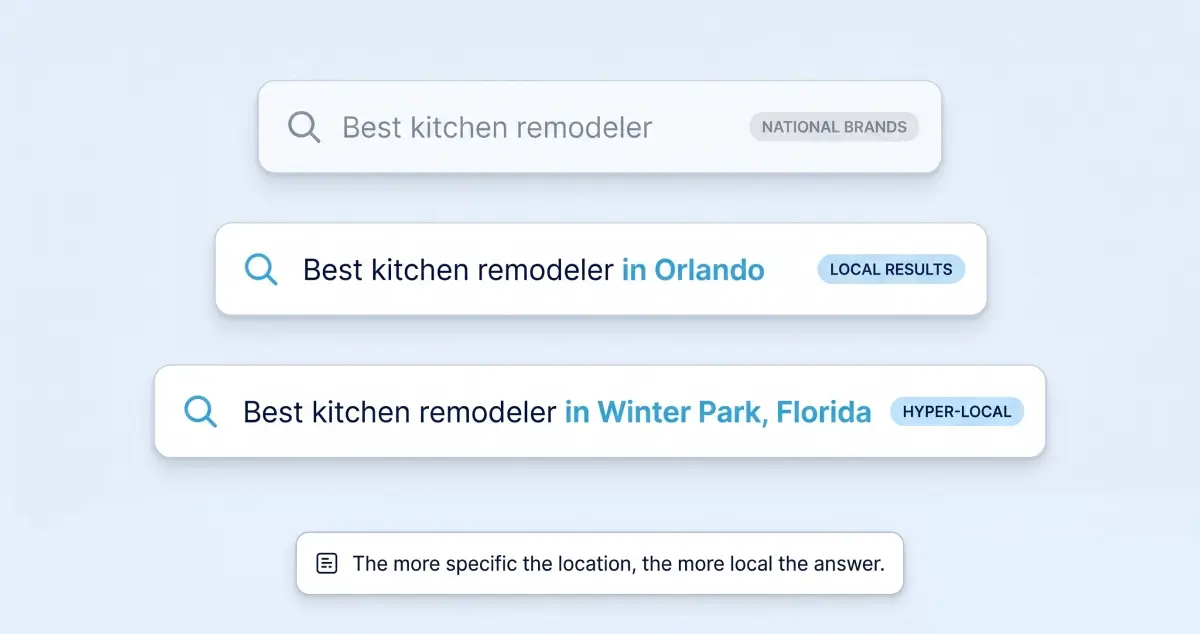
Think about the difference between these three questions a homeowner might type into ChatGPT:
"Best kitchen remodeler." Ambiguous. The AI has no idea where this person is or what market matters to them.
"Best kitchen remodeler in Orlando." Strong signal. Now the AI knows to look for Orlando businesses, Orlando reviews, and Orlando-relevant sources.
"Best kitchen remodeler in Winter Park, Florida." Stronger still. The AI can narrow to a specific submarket and pull hyper-local sources.
Every step down that ladder gives the AI more confidence about local intent. And here's the part that matters for your business: without a location in the prompt, AI models tend to fall back on broad, statistically safe answers. National brands. Generic advice. The big names everyone already knows. A specific location forces the model to look past those defaults and find the local entities that serve that market.
When someone does name a city, the AI does something worth understanding. It breaks the question into smaller searches, often called query fan-out. A prompt like "best commercial HVAC repair in Tampa" might fan out into several live web searches at once: top commercial HVAC Tampa, HVAC Tampa reviews, commercial HVAC contractors Tampa Bay. The AI then assembles its answer from whatever it finds across those searches.
This is why scattered, inconsistent business information hurts you. If your name, address, and phone number don't match across directories, review sites, and your own pages, the AI loses confidence in you and reaches for a competitor whose information lines up cleanly. Clean, consistent, locally relevant signals win these matchups.
Can AI tools tell where someone is without being told?
Yes, approximately. This one trips people up because it sounds like surveillance, and it isn't quite that.
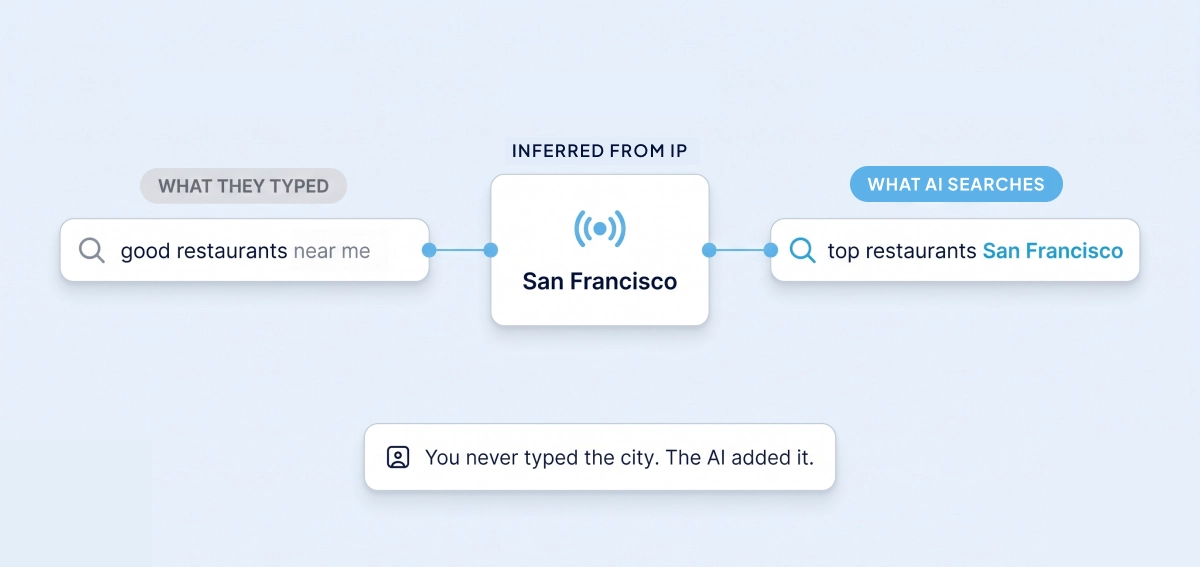
OpenAI states it plainly in their own documentation. ChatGPT collects general location information based on your IP address and may share that general location with third-party search providers to improve the accuracy of your results. Their own published example: if you ask ChatGPT for good restaurants near you and it determines from your IP address that you're in San Francisco, it may rewrite your prompt into the search query "top restaurants San Francisco."
Notice what happens there. The customer never typed "San Francisco." The AI inferred it and added the city behind the scenes. So even the bare "near me" question can become a city-specific search, and your local visibility still decides whether you show up.
One important nuance for the privacy-minded: the IP address itself stays private. ChatGPT may share approximate user location derived from an IP address with its search providers to improve accuracy, but the IP address itself is not shared with those providers.
How accurate is this? Not GPS-accurate. IP-based location generally gets country and region reliably, sometimes the city roughly, but precise street-level coordinates require explicit permission or another data source. A VPN, a mobile carrier routing a connection through a different city, or conflicting web signals can all throw the estimate off. So the inference is useful, but it's a best guess, not a pin on a map.
The "near me" trap nobody's talking about
There's a strategic consequence most local businesses haven't caught yet, and it's worth slowing down on.
For the last fifteen years, local SEO trained everyone to optimize for "near me." It became a keyword in its own right. Businesses wrote "plumber near me" into page titles, built content around it, and tracked their ranking for it. That made sense in a Google world, where "near me" was a literal phrase the search engine matched against.
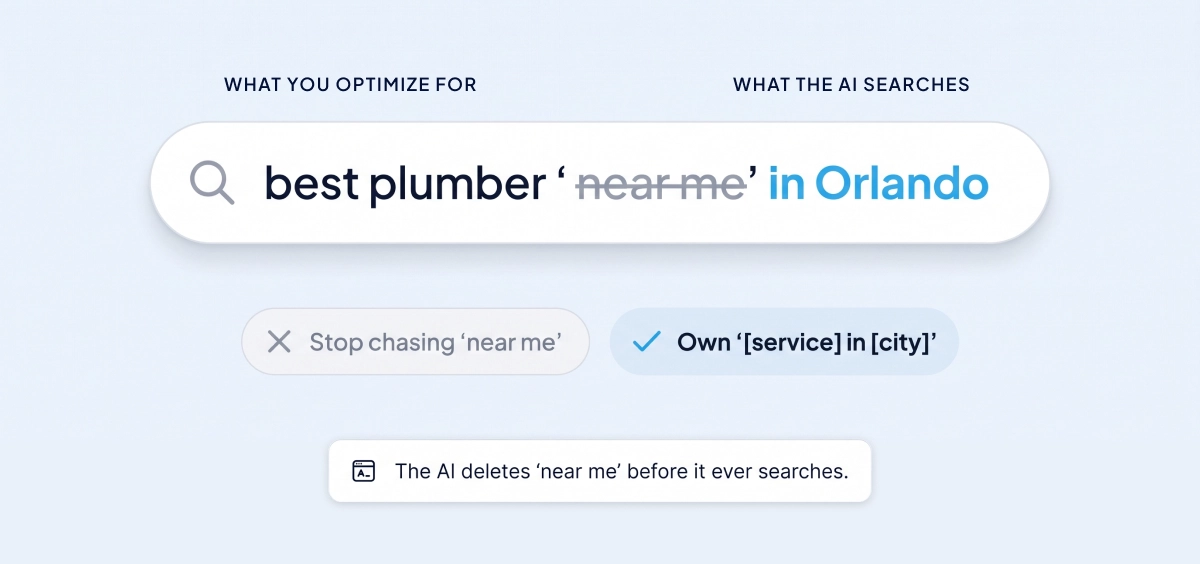
Watch what happens to that phrase in AI search. When a customer types "best financial advisor near me" into ChatGPT, the AI doesn't search for "near me." It infers the customer's city from their location, then rewrites the query into "best financial advisor in Orlando" before it ever runs a search. Google's AI does the same thing, quietly resolving "near me" against the customer's actual location. The phrase "near me" gets deleted in transit either way. It never reaches the part of the process that decides who shows up.
So businesses still pouring effort into "near me" as a keyword are optimizing for words the AI throws away. What the AI searches for instead is the rewritten version: your service plus your city. That is the phrase your content needs to own. The takeaway is plain. Stop chasing "near me" as a phrase and start owning "[your service] in [your city]" as an entity, because that rewrite is what the AI is really matching against.
The platforms don't all behave the same way
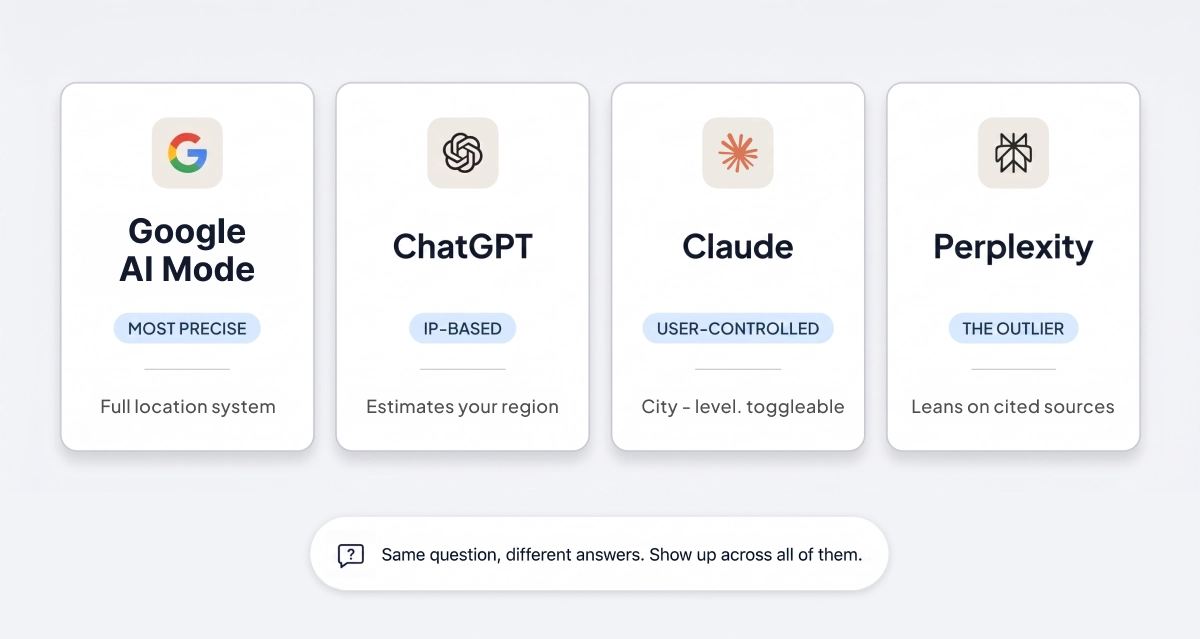
If you're tracking how your business shows up across AI tools, it helps to know that each one handles location differently.
Google is the one to watch most closely, and the surface that matters for local questions is AI Mode. AI Mode is Google's conversational search experience, and for a location query it returns what looks like a local pack built into an AI response, with business names, ratings, hours, and citations pulled from Google Business Profiles and across the web. It rides on Google's full location system. IP address, account history, and actual device location all feed in, so a location question auto-localizes without the user naming anything.
That gap is the sharpest platform difference to understand. Google localizes on your real device location, often down to the block, so two customers a mile apart can see different results. ChatGPT works from a coarser IP-based estimate that lands on your general city or region. Google is more precise about where you physically are. That precision is why traditional local ranking factors, proximity and a complete Google Business Profile, still carry real weight inside Google's AI, even as the format changes.
ChatGPT uses IP-based general location through its search tool rather than device GPS. It estimates your region, then rewrites prompts to add geographic context when it senses local intent. Accurate to a general city or metro area in most cases.
Perplexity is the outlier. Its whole product is built around answering with live, cited sources, so it depends on location for local-results queries in a way most other assistants don't, since the others generally won't assume your location unless you grant it.
For a local business, this spread matters. A customer using Google AI Mode and a customer using ChatGPT may get different answers to the same local question, drawn from different sources. Showing up consistently across all of them is the goal, and that consistency comes from the same foundation work, not from gaming any single platform.
What this means for your business
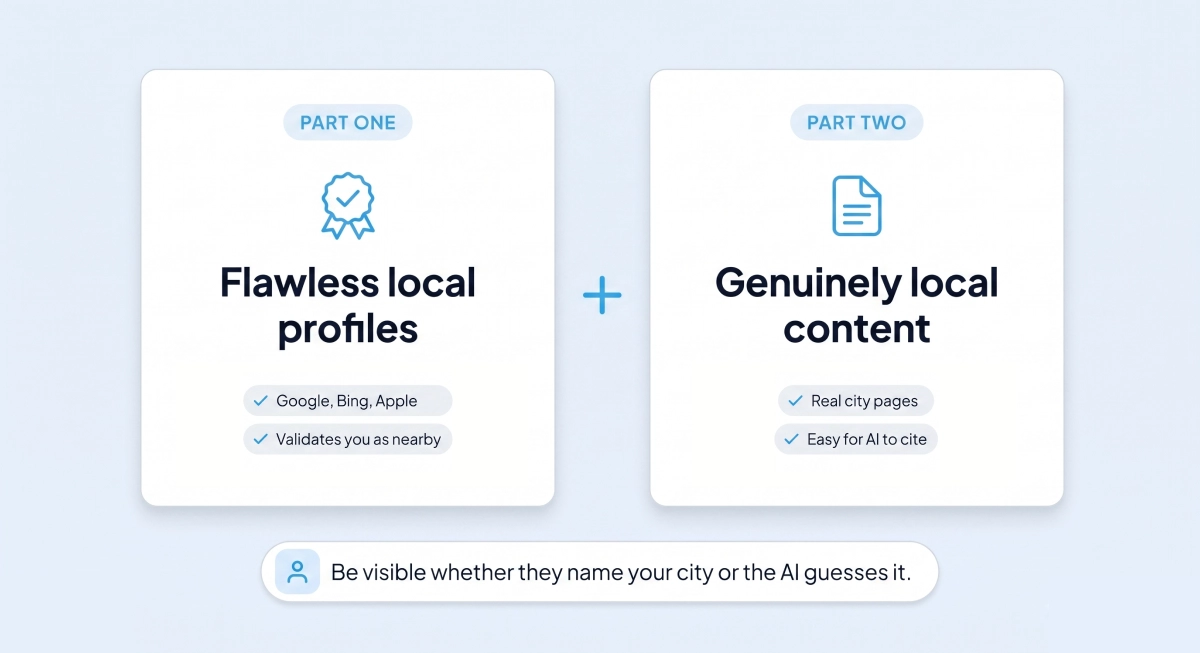
This is where it gets practical. Because explicit location terms beat inferred location, and because the AI infers location anyway, you need to be ready for both situations. That's a two-part job.
First, get your local profiles flawless. Google Business Profile, Bing Places, Apple Business Connect. When an AI tool does a proximity check based on a customer's estimated location, these profiles are what validate you as a real, nearby, legitimate business. Inconsistent or incomplete profiles get skipped. Strong profiles are the foundation that answers the "near me" and inferred-location scenarios.
Second, build genuinely local content. Dedicated, uniquely written pages for the cities and service areas you serve, with the geographic relevance built into the content rather than stapled on. When a customer does name a city, you want the AI to find a clear, well-structured page that directly answers that location-specific question and is easy to cite. A thin homepage trying to cover every market at once gives the AI nothing specific to grab.
These two pieces reinforce each other. Strong local profiles make you a trusted entity. Strong local content gives the AI something specific to pull when location intent is explicit. Together, they make you visible whether the customer names your city or lets the AI guess it.
This is the same work, incidentally, that strengthens your traditional Google rankings. Clean local signals, consistent business information, and deep location-specific content help you in search the way they help you in AI tools. You're not choosing between the two. You're investing in both at once.
Once the AI knows the location, what tips the citation to you?
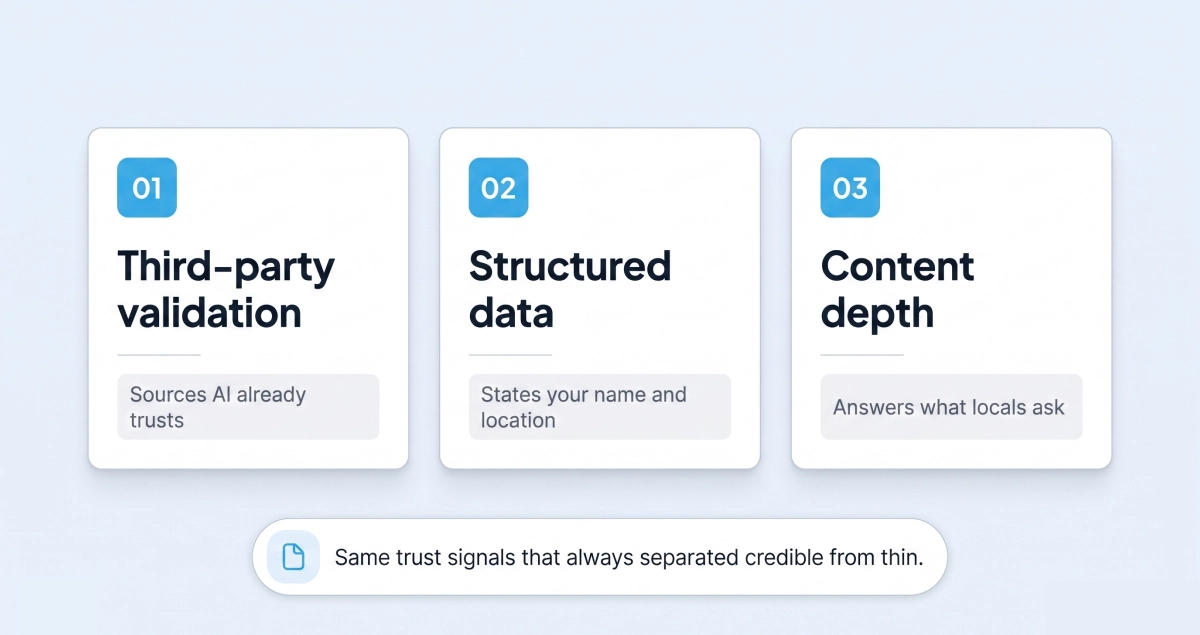
Getting the AI to recognize local intent is half the battle. The other half is being the business it names once it starts looking. Two competitors in the same city can both be locally relevant, and the AI still has to choose. Three things move that decision.
Third-party validation does heavy lifting. AI platforms lean on sources they already trust: reviews on established sites, local directories, industry listings, news mentions. When those sources point to you, the AI gains confidence. This is why scattered, thin, or unmanaged review profiles quietly cost you citations. The AI is cross-referencing whether the wider web vouches for you, and a competitor with stronger third-party signals wins that comparison even if your own website is nicer.
Structured data tells the AI exactly what you are. LocalBusiness, Service, and FAQ schema spell out your name, location, services, and answers in a format machines read cleanly. A page that makes the AI guess loses to a page that states it plainly. When two local pages are otherwise close, the one with proper schema is far easier for the AI to parse, trust, and cite.
Content depth settles a lot of these matchups. A 400-word service page with no real substance is easy for an AI to skip. A thorough page that genuinely answers the questions a local customer asks, with the location woven in naturally, is hard to overlook. Depth here doesn't mean padding. It means covering what someone in your market wants to know before they call.
None of these three is a trick. They're the same trust signals that have always separated a credible local business from a thin one. This is the core of what the industry now calls answer engine optimization, or AEO: making your business the one AI platforms trust enough to name. AI search just reads these signals more literally, and rewards them faster, than a human skimming a results page ever did.
Win the specific before you reach for the broad
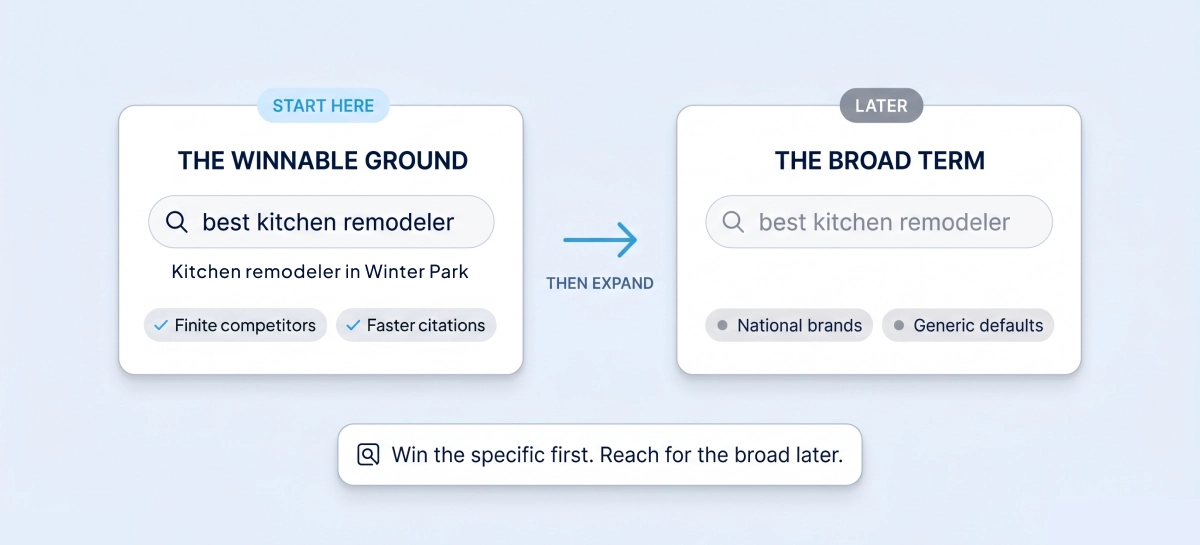
One sequencing point I push hard with every business in this position. If you're not yet showing up for the geo-specific prompts, the ones that name your city or neighborhood, don't start by chasing the broad, ungeo'd terms.
The temptation is understandable. "Best kitchen remodeler" feels like the bigger prize because it looks like more volume. But that bare term is where you're competing against national brands, aggregators, and every business in the country, and it's where the AI leans hardest on its safe, generic defaults. If you have near-zero visibility today, that is the hardest possible place to break in, and the effort rarely pays back.
The geo-specific prompts are the winnable ground. "Kitchen remodeler in Winter Park" has a smaller, clearer field. The AI is looking for local entities; your competitors in that exact market are a finite set, and clean local content plus solid profiles can move you into the consideration set faster. You earn citations there first.
That order matters for tracking, too. When you're deciding which prompts to monitor for your business, weight them toward the location-specific variants you can realistically win and measure, not the broad national terms that will read as a flat zero for months. Build the local foundation, prove movement on the geo prompts, then expand toward broader terms once the underlying signals are strong enough to compete for them. Reaching for the broad term first is how businesses work hard for a year and watch nothing move.
Why checking it yourself once will mislead you
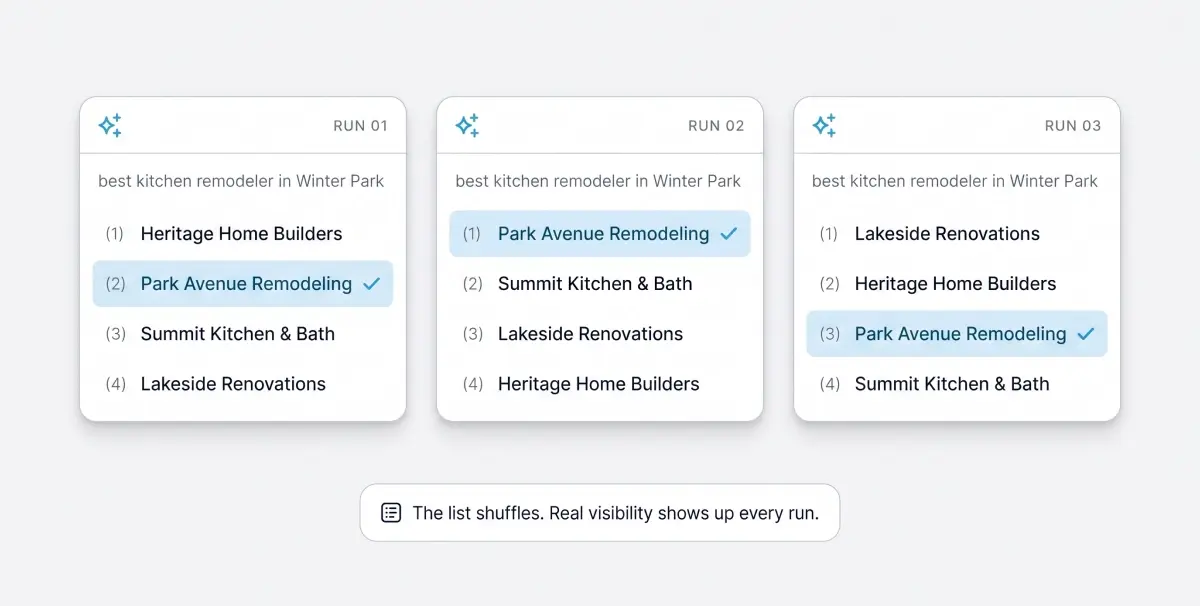
A lot of business owners read something like this, open ChatGPT, type in their city query, and treat whatever comes back as the verdict. If they show up, they relax. If they don't, they panic. Both reactions are built on a single data point, and a single data point in AI search is close to meaningless.
The reason is structural. AI responses aren't fixed. Ask the same question twice and you can get two different answers. A 2026 study from SparkToro and Gumshoe tested this directly, running nearly 3,000 prompts across ChatGPT, Claude, and Google's AI with hundreds of volunteers. Less than 1 in 100 runs produced the same list of recommendations, and getting the same list in the same order was closer to 1 in 1,000. So the result you saw on your one check could easily flip on the next run, in either direction.
That's the danger of the DIY spot-check. It can hand you false confidence on a good roll or false panic on a bad one, and neither tells you the truth about where you stand.
But something does hold steady underneath the noise. That same study found the top businesses in a category showed up in most responses, often more than half the time, regardless of how the question was phrased, and that consistency tends to be higher in local markets with fewer competitors. The industry has a name for this now: the consideration set. The specific ranking shuffles on every run, so tracking a "position" in AI is close to meaningless. What holds is whether you're in the pool the AI keeps drawing from. The businesses that have genuinely earned their visibility keep showing up. That pattern, not any single answer, is what real AI visibility looks like.
This is exactly why a one-off self-check and a structured audit are different things. The question that matters isn't "did I appear when I checked just now." It's "am I in the AI's consideration set consistently, across many prompts and all the major platforms?" Answering that takes repeated testing across ChatGPT, Claude, Perplexity, and Gemini, which is the gap a real audit is built to close.
Where most local businesses stand right now
Most local businesses I look at are relying on a single homepage to carry every market they serve, with business profiles that haven't been touched in years. That worked well enough when Google was the only game in town and a customer could scroll through ten blue links. It works far less well when an AI assistant is going to name one or two businesses, full stop, and move on.
The businesses that win the AI visibility race in their market are the ones treating location as a first-class signal: clean profiles, real city pages, consistent information everywhere a crawler might look. None of it is exotic. It's foundational work done deliberately, which is exactly the kind of work that compounds over time.
If you want to know how your business shows up today when a nearby customer asks an AI assistant for a recommendation, that's measurable. We run a HireAWiz AI Visibility Audit that pulls real responses from ChatGPT, Claude, Perplexity, and Gemini using the kinds of location-specific prompts your customers actually type, and shows you exactly where you stand against the competitors getting cited in your market.
The first question that audit usually answers is the one Marie asked me last week. The second question is always the same: what do we do about it? That part is answerable too.

Related Articles
Business owners trying to get more visibility ask me one question more than any other. People just starting to learn…
I gave a presentation last week to a company weighing whether to invest in SEO and AI search visibility. The…
A longtime HireAWiz client, I’ll call her Jane, came to me recently with new website content she had built with…
Ready to Find Out Where You Stand?
No pitch. No pressure. Just a conversation about what's working, what's not, and where the opportunity is.
The AI Visibility Audit is free and shows you exactly how your business appears across ChatGPT, Perplexity, Claude, and Gemini before you invest a dollar.

5.0


