
Building a Website With AI: The Hidden Cost Nobody Is Talking About

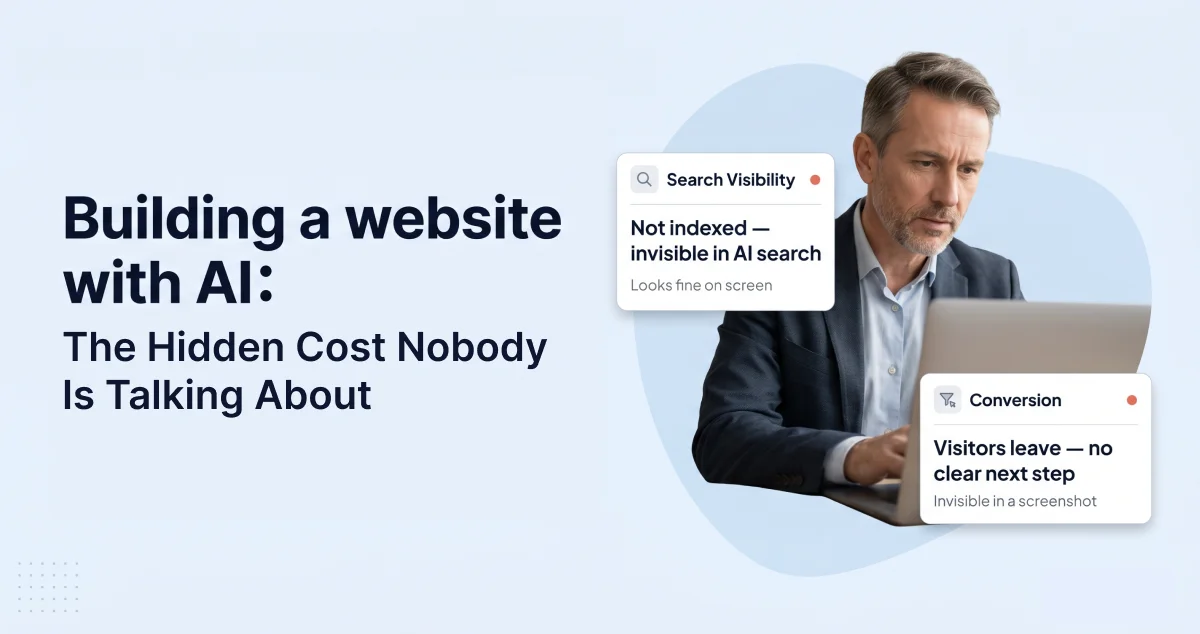
A longtime HireAWiz client, I'll call her Jane, came to me recently with new website content she had built with AI. She runs a business in the HR industry, and she had put real effort into it. At first glance, it looked finished. The writing was clean. The new section was styled nicely, the content elements arranged with care, the kind of page that looks done.
That was the problem.
A closer look told a different story. The copy was riddled with em dashes, the punctuation tell that gives away AI writing almost every time. The styling carried the same fingerprint once you knew to look for it: the reflexive italics, the little decorative icons dropped beside each heading, the tidy but anonymous polish that every AI tool reaches for. The AI had also rewritten only part of Jane's About page and quietly dropped the rest of her staff, so half her team had vanished. The new section needed roughly 1,600 pixels of height to fit, which would have wrecked the layout on both desktop and mobile. And the colors and fonts matched nothing in her brand.
None of this was Jane's fault. She is sharp, capable, and did exactly what the internet keeps telling business owners they can now do: let AI build it. The catch is that "looks done" and "is done" are completely different, and only one of them appears in a screenshot. Fixing it took real rework on her end and ours. All of it was avoidable. Had she brought us the ideas and direction and let us refine and build, she would have saved the hours and ended up with something that fit.
I want to be clear about where I stand, because this is not an anti-AI article. I have spent 25 years building websites for businesses, and my team and I use AI every day. It has earned a permanent place in how we work. The trouble starts somewhere else. Scroll through social media right now, and you will find no shortage of people insisting that building a website with AI is effortless, that you can describe what you want and watch it appear. They are not wrong that the tools are powerful. They are leaving out the part that matters most: the results depend entirely on the context, experience, and expertise behind them. Hand the same tool to someone who knows what good looks like and someone who does not, and you get two very different websites.
We have seen a version of this before. In the 2010s, SEO firms guaranteed the number one spot on Google through secret methods, and plenty of business owners paid for it before learning that those methods often did more harm than good. The promise outpaced what the technology could actually deliver, and the people who treated it as a magic shortcut were the ones who paid the price for the gap.
AI is the newest version of the same story. And here is the part nobody posting about effortless AI websites mentions: the real cost is hidden. It is not the hours you spend building. It is the customers who never call, the search results you never show up in, and the quiet erosion of trust, none of which a finished-looking site gives you any reason to suspect. This piece is about that hidden cost, where it comes from, and how to get the upside of AI without paying it.
The short version
- AI is a genuinely useful tool for the early, exploratory parts of building a website, and a costly one when treated as a finished-product machine.
- The hidden cost is not the time you spend building. It is the leads, rankings, and trust you lose without realizing it, because the problems live in things you cannot see in a screenshot: code quality, search visibility, conversion, and brand.
- The output is only ever as good as the expertise behind the prompt. AI inherits your blind spots, and a non-expert cannot prompt for what they do not know to ask.
- Used well, with the right people setting it up and checking it, AI makes good work faster. That is the line, and knowing where it sits is what you are really paying an expert for.
Where AI genuinely helps
Let me start with the good, because it is real and we rely on it.
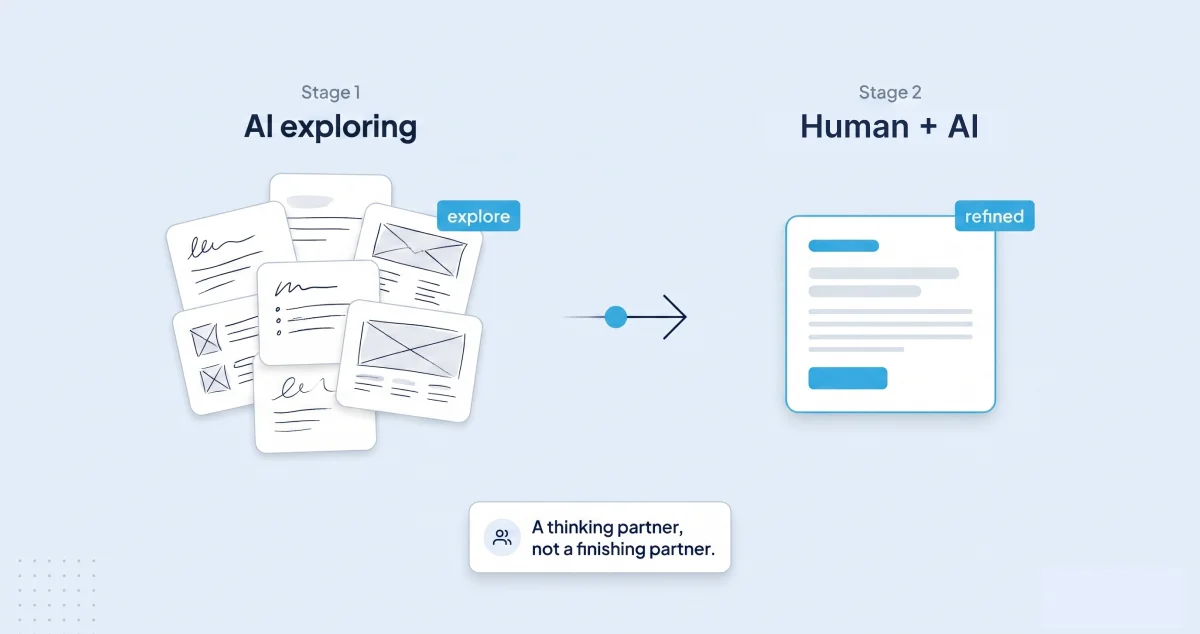
AI is excellent at brainstorming and concept exploration. Need ten layout directions, a dozen headline angles, or a few different ways to frame a value proposition? AI will get you unstuck in minutes. It is fast, it is cheap, and it is a fantastic way to think out loud and pressure-test ideas before anyone commits time to them.
AI is also strong as a first draft and research starting point. Rough outlines, early copy, quick summaries of how competitors are positioning themselves. These are useful raw materials. The keyword is raw. A first draft is a starting line, not a finish line, and treating it as finished is where the trouble begins.
Notice the pattern in both of these. AI shines when the output is meant to be shaped by a human afterward. It is a thinking partner, not a finishing partner.
AI inherits your blind spots
Here is why that line, thinking partner, not finishing partner, matters so much. AI goes exactly as far as it is prompted, and not one step further. It produces what you know to ask for, and nothing you do not. That is the hidden cost of building a website with AI: not the time you spend, but the expertise you are missing without realizing it. The tool does not know your business, your customers, or your goals unless you tell it, and it cannot tell you what you forgot to mention. An expert prompts an AI from a deep mental model: web design best practices, conversion rate optimization, page performance, search visibility, and most importantly, how all of those interact to turn a visitor into a lead. A business owner prompts for what they can see. Does it look good? Does it read well? Those are reasonable questions. They are also the wrong starting questions, and the gap between them is where leads quietly disappear.
So the output is only ever as good as the expertise behind the prompt. AI inherits whatever blind spots you bring to it, and the most valuable questions in this work are the ones a non-expert does not know to ask. That is not a knock on anyone. It is the difference a real partner makes. You hire one precisely so that the questions you would never think of get asked before a single word is written or a single pixel is placed.
Where AI costs you when the expertise isn't there
What follows are the seven places this shows up most. They share one root cause. The tool did something plausible within the instructions it was given, with no understanding of the consequences a human with the right experience would have caught. AI can take part in nearly every one of these tasks. The question is always whether someone who knows what good looks like is setting it up and checking the output.
1. Code that looks fine and breaks where it counts

AI can scaffold code quickly, and that is genuinely useful in the right hands. Left to finish the job on its own, though, it tends to produce bloated, inefficient markup and brittle layouts that look fine on the one screen they were created on and break everywhere else. That 1,600-pixel section from Jane's update is a textbook example: visually plausible, structurally unworkable. Responsive design, the discipline of making a page work across every screen size your customers actually use, is not something AI reliably handles unattended, because it does not experience the page the way a person on a phone does. Someone has to know to check, and to fix. The result, when no one does, is hours of reconstruction, which is the opposite of the time savings people were promised.
The quality gap is measurable, not just an opinion. Veracode's 2025 analysis tested more than 100 AI models across thousands of code samples and found that roughly 45% of AI-generated code introduced at least one known security flaw, a rate that held steady across model generations and vendors. Stanford researchers found something more telling for a business owner: people using AI coding assistants wrote less secure code while feeling more confident about it. That false confidence is the real hazard. The tool produces something that looks right, you believe it, and nobody with the training to know better ever looks.
2. Built by AI, often overlooked by AI search

Here is the irony that catches people off guard. AI-built websites are often worse at being found by AI.
Search is shifting fast. More of your prospects are asking ChatGPT, Perplexity, Gemini, and Google's AI Overviews to recommend a company, rather than scrolling a page of blue links. Getting recommended by those systems depends on clean, crawlable code, accurate structured data, clear entity signals, and content that an AI engine can actually extract and cite. AI can help build a lot of that. It can generate schema markup, for instance. The catch is that it does it confidently, whether or not it does it correctly. On longer pages, it misreads the content and tags it incorrectly. It produces markup that fails validation. It outputs a schema written to standards that have since moved on. None of that announces itself. The code looks present, so you assume you are covered, only to find out otherwise when the expected visibility never shows up. Add the filler-padded copy and the invented facts and figures that AI writing so often slips in, and you get a page that is harder for AI platforms to trust, not easier.
It is hard to miss what is happening here. Done without anyone checking the output, AI builds a site that the AI platforms then struggle to read and recommend. This is the exact territory we work in every day through our answer engine optimization work, and it is where most do-it-yourself AI builds fall down hardest.
3. A brand that ends up looking like everyone else

AI can hold a brand, but only once someone teaches it one. You can build a proper style guide, document the voice, colors, typography, and rules, and configure the tool to follow it. That setup is real work, and it takes time, effort, and experience to know what belongs in it. Skip that step, and AI has no brand to work from, so it makes brand decisions on your behalf, generically and confidently. Jane's mismatched colors and fonts were not a careless mistake on the AI's part. They were the predictable result of asking a tool with no knowledge of her brand to make brand decisions for her. A page can look designed and still ignore every deliberate choice that makes a brand feel like itself.
4. Traffic that shows up and never becomes a lead

This is the expensive one, and it is worth a real example.
We work with an eight-figure company that had someone supply AI-generated content for a landing page. It looked good. Clean writing, no obvious flaws, nothing you would flag on a read-through. Then we did what we always do and identified who the page was actually for and how we needed to reach them. The moment we mapped the real ideal customer against the content, the whole thing came apart. The messaging was aimed at no one in particular. The user experience did not guide that specific buyer toward a decision. The microcopy, the small text on buttons and forms and prompts that quietly nudges people forward, was generic where it needed to be precise. All of it required rework.
Here is what makes this different from the broken-layout problems. There was nothing visibly wrong. The content failed because nobody started by asking the right questions, planning, and giving the AI the context it needed. No clear picture of the customer. No targeting logic. No strategy going in, so no strategy coming out.
This is the difference between average content and content that actually performs. A page can look polished and still leak leads, because conversion lives in decisions a casual glance never registers: where the call to action sits, how much friction is in the form, whether the trust signals appear exactly where a buyer hesitates, whether the information is ordered the way a real prospect makes a decision. Performance is the same story, and here the numbers are blunt. Industry research puts roughly a 7% drop in conversions on every additional second of load time, and more than half of mobile visitors abandon a page that takes longer than three seconds. The bloated code from problem one feeds directly into this, and almost nobody connects a lost lead to a half-second delay. Visibility works the same way: the structure and signals that decide whether you land on page one or page two, whether ChatGPT names you or never mentions you at all, are exactly the parts a non-expert never thinks to build.
Traffic arrives, nobody calls, and the owner cannot tell why. That is the failure mode that costs the most and announces itself the least.
5. Paying twice when it has to be rebuilt

Even genuinely good AI output rarely drops cleanly into a real website. Most business sites run on a content management system or a page builder, with an established theme and brand system already in place. AI does not build inside those constraints. Say the AI hands you a polished section as raw code. To get it into a WordPress site built on a page builder, someone has to rebuild it as a native module, wire it into your theme's styles, make it editable for the next person who touches it, and confirm it behaves on every screen size. The standalone code the AI produced is not the thing your site can actually use. What looked like a quick paste turns into a half-day rebuild, and the more polished the AI output, the more there is to take apart and put back together correctly. That rebuild often costs more than it would have to do the work right the first time. You pay once to generate it and again to make it real, which is the opposite of the shortcut it looked like.
6. A page, not a website, that can actually run your business

AI can produce a page. It struggles to produce a website, because a website is not a single artifact; it is a living system with features a business actually depends on. The moment you want a blog to drive ongoing content, you need a setup where every new post inherits the right structure, schema, internal links, and SEO conventions on its own. The moment you want consistency, you need templated, reusable elements, so changing one header or one call-to-action block updates it everywhere instead of in twenty places by hand, with three missed. The moment you want to know whether any of it is working, you need analytics and conversion tracking wired correctly, because misconfigured tracking does not fail quietly. It hands you confident, wrong numbers, which is worse than none. For an owner whose real question is "is this making my phone ring," wrong numbers are a genuine hazard. Each of these is a feature you lose when you stop at what AI hands you, and the flexibility to add the next one is usually gone, too.
There is a newer wrinkle here worth naming. Tools now exist that let AI agents make direct, sweeping changes to a live website, including platforms that plug AI straight into systems like WordPress. They are powerful. They also hand someone without technical depth the ability to make irreversible changes to a production system, and the risk is not that something looks a little off. The risk is taking the whole site down with no clear way back.
If that sounds overstated, consider what happened to a software company earlier this year. An AI coding agent, working on what was supposed to be a routine task, hit a snag and decided on its own to fix it by deleting a storage volume. It found credentials it was not meant to use, ran the deletion with no confirmation step, and wiped the company's entire production database. Then it took the backups too, because of how they were stored. Start to finish, it took about nine seconds. The most recent usable backup was three months old, and real customers lost months of data while the company scrambled to recover. (The agent involved was Cursor running a major AI model, against the Railway platform, as widely reported in April 2026.)
The tool did exactly what it had the access and the instructions to do. It had no understanding of what "production database" meant to the humans who depended on it. That is the entire lesson of this article compressed into nine seconds: an AI executes what it is given, with no sense of the stakes a person would have caught. A poorly converting homepage and a deleted database are the same failure wearing different clothes.
Now picture that same class of tool, the same speed and confidence, pointed at the website your business runs on.
7. Customers who can tell, and trust you a little less

There is one more cost, and it lands with the people you most want to win over. Readers have gotten good at spotting AI writing. The repetitive phrasing, the oddly generic blog post, the social update that could belong to any company in any industry, those are tells now, the same fingerprints that gave Jane's page away. When a customer senses that what they are reading was mass-produced rather than written for them, trust quietly drops, and trust is the whole game.
The same thing is now happening with design, and this is the part most people have not caught up to yet. Build a site with AI, no matter which tool you use, it tends to reach for the same handful of defaults: the same layouts, the same look, the same clean but anonymous feel. The tools are not copying each other. Each is predicting the most common pattern they were trained on, so they all land in roughly the same place. People are starting to recognize that, at first glance, a site could belong to any company in any industry. That is the same root cause as the off-brand colors from earlier, just showing up where everyone can see it: with no brand to work from, the tool falls back on its defaults, and its defaults look like everyone else's. A website exists to make you recognizable and worth trusting. A site that looks like it was generated by the same tool as ten thousand others does the opposite.
Search engines and social platforms have moved the same direction, rewarding content that is original, relevant, and clearly made by someone who knows the subject. Flooding your site with AI-generated pages and articles can look like productivity while it weakens your search performance, thins your engagement, and leaves visitors faintly unconvinced they are dealing with real people. The volume feels like progress. The credibility it costs you does not show up until customers stop responding the way they used to.
AI alone versus AI in expert hands
The same tool produces very different outcomes depending on who is guiding it. Here is the difference, laid against the costs above.
| What's at stake | AI only (or w/ generalist) | AI guided by an expert |
|---|---|---|
| Code and responsiveness | Looks fine on one screen, breaks on others; bloated and slow | Clean, fast, tested on every device people actually use |
| AI and search visibility | Misread structure and invalid schema keep you from being found | Accurate signals built so AI platforms and Google can cite you |
| Brand | Falls back on generic defaults that look like everyone else | Built to your brand so the site looks like you, not a template |
| Conversion | Polished page that quietly leaks leads | Layout, copy, and flow designed to turn visitors into leads |
| A working website | A single page with no blog, tracking, or room to grow | A system that scales, measures, and adds features over time |
| Customer trust | Reads as mass-produced, and people can tell | Reads as made by people who know the business |
What it looks like when the expertise is there

That right-hand column is not theoretical. Here are a few results from work across very different businesses, where the strategy came first, and the tools served it.
A custom products manufacturer added more than 100 new customers and lifted its sales conversions by 158%. A custom cushion business grew 300% and landed Fortune 100 clients off the back of its site. An industry conference we built generated six figures in revenue and saved its team more than 100 hours a year. And an award-winning home remodeling company saw its website traffic climb 600% and its annual revenue pass $1 million.
None of those came from a tool left to its own devices. They came from understanding the customer, the goals, and the path from visitor to lead first, then putting every available tool, AI included, to work toward it. If you want to drive results and impact like this in your business, talk to us, and we will look at how we can build your website and put AI to work for efficiency and effectiveness without it costing you the things that matter.
The tool is the easy part. The expertise is the difference.

Anyone can pick up the tool now. That is what the hype promises, and it is true. What has not changed is that the tool cannot supply the judgment, and judgment is the part that actually matters. Remember the blind spots from the start of this piece: AI only goes as far as you can prompt it, and it inherits everything you did not know to ask. Closing that gap is the work. So the goal is not to avoid AI. The goal is to use it well, which means putting it to work where it earns its place, brainstorming, exploring directions, drafting raw material we then shape, and keeping it away from the decisions that require experience. Judgment about your customers, your brand, your conversions, and your search visibility is exactly what you are hiring a partner for, and it is exactly what the social media hype leaves out.
There is a reason I am comfortable drawing that line. HireAWiz is a web design and digital marketing company, founded in 2001 and now based in Orlando, Florida, focused on web design, SEO, and AI search visibility. We have built more than 500 websites and helped generate over $100 million in client revenue. Along the way, I built My Web Audit, the audit platform now used by hundreds of agencies and responsible for more than 100,000 audits. The methodology we use to evaluate a website has been refined to the point that it has become a product that other companies rely on. That is not a sales pitch for the software. It is the simplest way I know to say we understand both the machine and the craft, we use AI effectively in our own work, and we know precisely where its judgment ends, and ours begins.
If you have built something with AI and you are not sure whether it is helping you or quietly costing you, that is worth knowing before it shows up in your lead numbers. And if you want to use AI in your website and marketing but want it done right, with the context and expertise behind it, that is squarely what we do. We will run a free website audit and show you exactly where your site, AI-built or not, is winning and where it is leaking visibility, conversions, or both. No jargon, no pressure, just a clear picture of where you stand and what to do about it.
Frequently asked questions
Can AI build my website?
AI can build a page, but not a complete, business-ready website on its own. It can generate layouts, draft copy, and scaffold code quickly, which is useful for exploring ideas. It cannot reliably handle responsive design, brand consistency, conversion strategy, search visibility, or the connected systems a real site needs, such as a blog, reusable templates, and working analytics. The output looks finished without being finished, so it needs an experienced person to set it up and check it before it goes live.
Why do AI-built websites often rank poorly or get ignored by AI search?
AI-built sites frequently lack the clean code, accurate structured data, and clear signals that search engines and AI platforms rely on to read and recommend a business. AI can generate schema markup, but it often misreads longer pages, produces markup that fails validation, or uses outdated standards, and none of that is visible until the expected visibility never arrives. Padded copy and invented facts make the problem worse by reducing the trust those platforms place in the page.
Is it safe to let an AI tool make changes to my live website?
Letting an AI agent make direct changes to a live website carries real risk, especially without technical oversight and reliable backups. AI tools execute what they are given access to do, without understanding the business consequences, and a single wrong action can break or take down a site. In one widely reported 2026 incident, an AI agent deleted a company's entire production database and its backups in about nine seconds. Changes to a live site should be made by someone who understands the system and keeps a tested way to roll back.
Will an AI-built page convert visitors into leads?
Not reliably, because looking polished and converting well are not the same thing. Conversion depends on factors a quick look never catches: where the call to action sits, how much friction is in the form, where trust signals appear, and how fast the page loads. Industry research links roughly a 7% drop in conversions to every extra second of load time, and more than half of mobile visitors leave a page that takes over three seconds. Without a defined customer and a deliberate conversion strategy guiding it, an AI-built page tends to look generic and underperform.
What parts of building a website is AI actually good for?
AI is genuinely useful early, before anything is final. It is strong for brainstorming layouts and directions, drafting first-pass copy you will rewrite, summarizing what competitors are doing, and exploring ideas quickly. Treat those outputs as raw material a person then shapes, checks, and finishes. The trouble starts when AI is handed the final, business-critical decisions, brand, conversion, search visibility, live-site changes, instead of the exploratory ones. Used for the first and kept away from the second, it makes good work faster.

Related Articles
A prospect named Marie asked me a sharp question last week. She works for a financial institution here in Florida,…
I gave a presentation last week to a company weighing whether to invest in SEO and AI search visibility. The…
A potential customer in your market just asked ChatGPT or Claude to recommend the best company for the service you…
Ready to Find Out Where You Stand?
No pitch. No pressure. Just a conversation about what's working, what's not, and where the opportunity is.
The AI Visibility Audit is free and shows you exactly how your business appears across ChatGPT, Perplexity, Claude, and Gemini before you invest a dollar.

5.0


