
Our proven AI search content strategy to generate qualified leads for clients

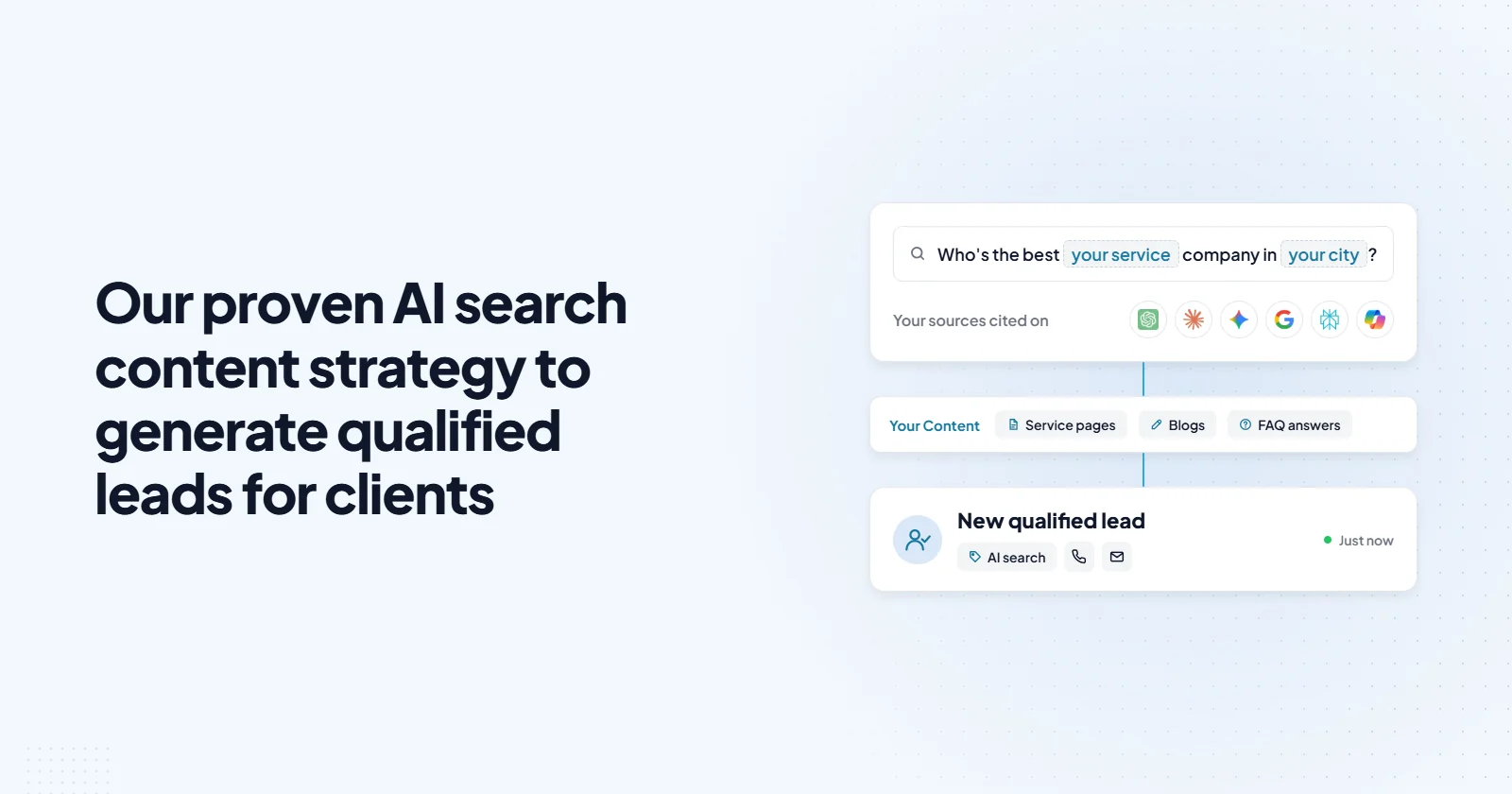
A business owner looked at their AI visibility audit for the first time and said, "So my competitor is showing up on ChatGPT and Google AI Overviews for many of the search terms I care about, and I'm not on there at all?" Then came the question that matters: "How can I show up?"
That question is the job. Since 2001, first in Phoenix and now through our Orlando answer engine optimization company, my team and I have watched businesses put real money into SEO strategies where content ranked and never produced a phone call or form submission. The content was fine. The strategy behind it was the problem.
The short version
What content should your business publish to show up in AI search? Start with the questions your customers already ask AI about your service, confirm which of those lead to a sale, check who the AI platforms cite today, then fix the pages you already have before you write new ones. Most businesses skip the first two steps and publish content that ranks and never makes the phone ring.
These are the same five steps we run for SEO. AI search changed the inputs, mostly which questions we test and who gets cited, not the order of work.
Why does content that ranks still produce no leads?
A content strategy built from a keyword list measures impressions and rankings, and both can look good while the business gets nothing.
The clicks are also smaller than they were. Ahrefs re-ran its AI Overviews study on December 2025 data and found that when an AI Overview appears, the top-ranking page gets 58% fewer clicks than it used to. Position two loses about half. Even position ten loses nearly a fifth. Ranking first for a term Google answers itself is a smaller prize than it was two years ago.
Notice what that does to a keyword-first strategy. You win the term, the report shows a green arrow, and the phone stays quiet because the answer was already on the results page.
I see a second version on sites we audit, and I have seen it on our own. Long, conversational questions rank well and almost never click, while the searches tied to a sale sit on page two or three. A report that averages both looks healthy. The business is not.
1. Start from what a lead is worth, not from a keyword list
Every topic gets measured against one yardstick: how close it sits to an ideal customer contacting you.
Before we open a keyword tool, we ask three questions. What is a new customer worth to you? Which service do you want more of? What does a good month look like in leads, not in traffic? A remodeler who wants more kitchen projects and one who wants more insurance restoration work need different content, even though a keyword tool would hand them the same list.
When an owner says "just tell me what to write," my answer is the same every time. We find out what your business is best known for as a service, where your reviews are strongest, what Search Console says you already rank for, and which prompts AI platforms cite you for. Those are data signals, and they decide what gets written before any keyword tool does.
One opinion I will state plainly: if you cannot name the service you want more of, do not invest in content yet. Holding the money beats publishing pages that measure nothing.
2. Find out what your customers actually ask AI
The questions your customers ask ChatGPT, Claude, Perplexity, and Google AI are the content list. We run them instead of guessing.
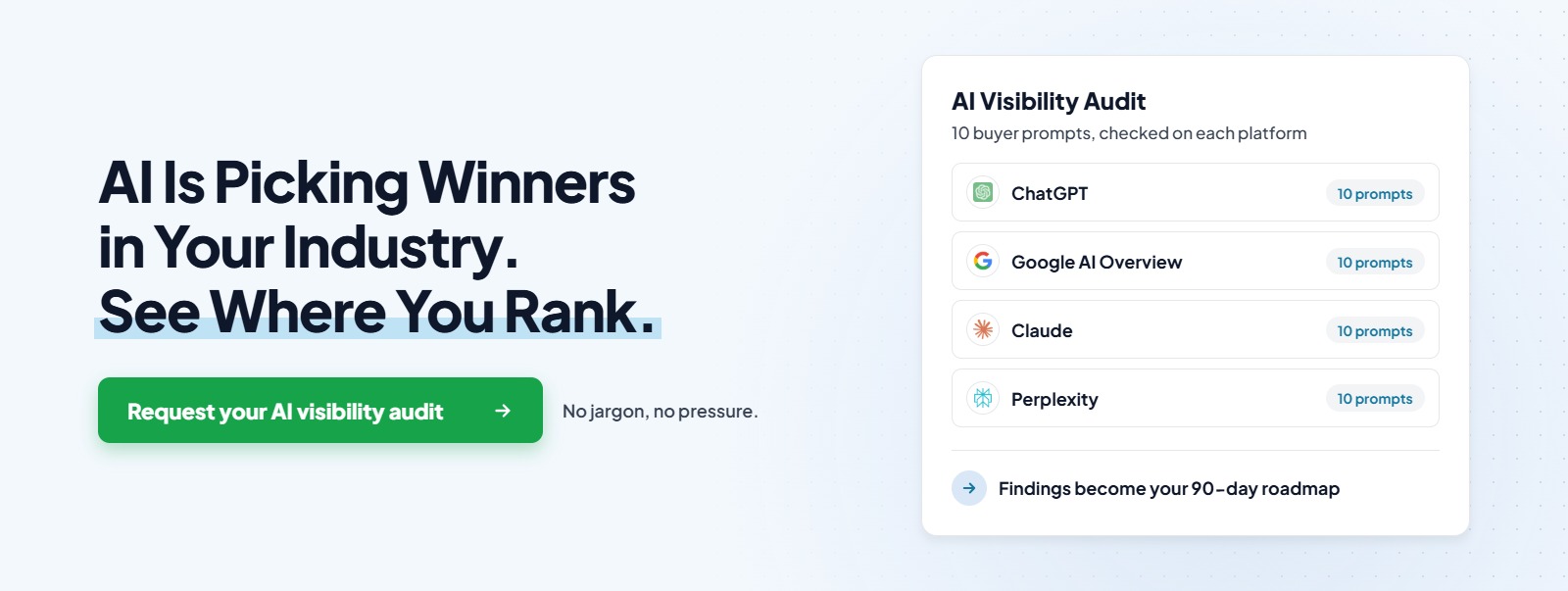
Our AI visibility audit takes the prompts a real customer in your market would type, runs them across the four major AI platforms, and records who gets cited and which pages the citation points to. For every prompt where your business is missing, we ask one question: does the page that would answer this even exist on your site? If not, that is a page to build. If it exists and is not cited, that is a page to fix. I built My Web Audit, the platform behind this audit. It has generated more than 100,000 audits for hundreds of agencies, so we've tested the method well beyond our own clients.
One caveat. The same prompt returns a different list on different days, so one run of ChatGPT on your phone proves nothing either way. We run the prompts repeatedly and measure which businesses show up consistently. That is the set your content has to earn its way into. The detail is in what an AEO audit measures.

3. Is this question worth a page?
A question is worth a page only if the page can win where that question is answered. So we look at the actual results page for each one, on Google and on the AI platforms, before we commit. Three shapes come up again and again.
| What the results page shows | What it means for your business | What we do |
|---|---|---|
| A map pack at the top | The searcher wants a nearby business now | A service page plus your Google Business Profile, not a blog post |
| Directories and national lists filling most of the page | A local company's page is unlikely to place on the broad term | Target the more specific version of the question where local companies already appear |
| An AI Overview or AI answer on top | The goal now includes being cited inside the answer | Study what the cited sources have in common (a cost table, a step list, a definition) and build the better version |
The map pack case is the one businesses get wrong most often. They commission a long article for a question an article was never going to answer.
4. Group the questions into pages, then fix what you already have
A list of questions is not a strategy. We group the questions by what the customer wants, and each group becomes one page: a service page, a cost post, a comparison. One page per thing a customer wants, with the related questions answered on it.
Then comes the step most strategies skip. Before we write anything new, we check what the site already ranks for. A page sitting on page two for a question you care about is a rebuild, not a reason for a second page. Two pages competing for the same question help neither.
Rebuilds of pages that already rank come first. New pages for questions you are missing from entirely come second. Within each list, the order is set by how close the page sits to a lead, with search volume as the tiebreaker, not the filter.
5. Write so an AI platform can lift the answer
The writing has to work for a person skimming on a phone and for a machine looking for a quotable answer. Both reward the same things. Every section opens with the answer, then the support. Headings read like the question a customer would ask. Comparisons go in tables. Numbers carry a named source and a date. Your business, your city, and your service are named plainly. Schema markup and a visible updated date go on every page. The Growth Stack post covers how this layer sits on top of your website and your SEO.
The part no competitor can copy comes from your own work: the job you did last month, your typical timeline, the mistake you see customers make. That material is what makes a page worth citing, and we ask every client for it before we write. Everything in this step is also what Google ranks, which is why we never run an AEO strategy and an SEO strategy as two projects.
| Step | What we use | What it produces |
|---|---|---|
| 1. The lead | What a customer is worth and which service you want more of | The yardstick every topic is measured against |
| 2. The questions | AI visibility audit: real prompts on four platforms, who gets cited | The list of questions you are missing from |
| 3. The answer page | A read of each results page: map pack, directories, AI Overview | Which questions deserve a page and what it must contain |
| 4. The pages | Your current site and what already ranks | Rebuild list first, new page list second |
| 5. The writing | Answer-first structure, sources, schema, dates | Pages an AI platform can lift and cite |
What this looked like on our own site
We rebuilt hireawiz.com in April 2026, after moving the company from Phoenix to Orlando and adding AI search visibility to our services. The first AI visibility audit on the new site, run April 9, 2026, was the baseline, and it was not flattering. On the prompts that mattered most- an Orlando business owner asking an AI assistant who handles answer engine optimization- we were nowhere.
We ran the five steps on ourselves. The question to win was the one our customers ask: who in Orlando does this work? The answer pages were full of national lists and directories, so we aimed at the Orlando-specific versions where local companies appeared. The page that would answer it already existed, so we rebuilt it instead of writing something new.
By the end of June, less than 90 days later, the refreshed audit showed Google AI citing HireAWiz first for the prompt "Who is the best AEO agency in Orlando?" We were absent on that prompt in April. The citations turned into a phone call, too. This year, an enterprise client found us by asking an AI assistant for the best answer engine optimization companies in Florida and hired an AI visibility and SEO audit based on that answer. We've held that position as one of the top recommendations since. Here's a screenshot from today, October 5th, 2026, when we are publishing this blog.
The same process then told us something less comfortable. Our Orlando SEO page sat on page two for the searches closest to a sale while newer posts ranked well for questions that rarely click. So the next work on our own site is a rebuild of our Orlando SEO page, ahead of any new blog post. Step 4, applied to us.
What it looked like for a remodeling client
Todd Whittaker Drywall has been a client for more than ten years, and the same five steps have run their content strategy the whole time. The yardstick was never just traffic. It was the type of project they wanted more of. They are best known for drywall repair and texture work, and their reviews are strongest there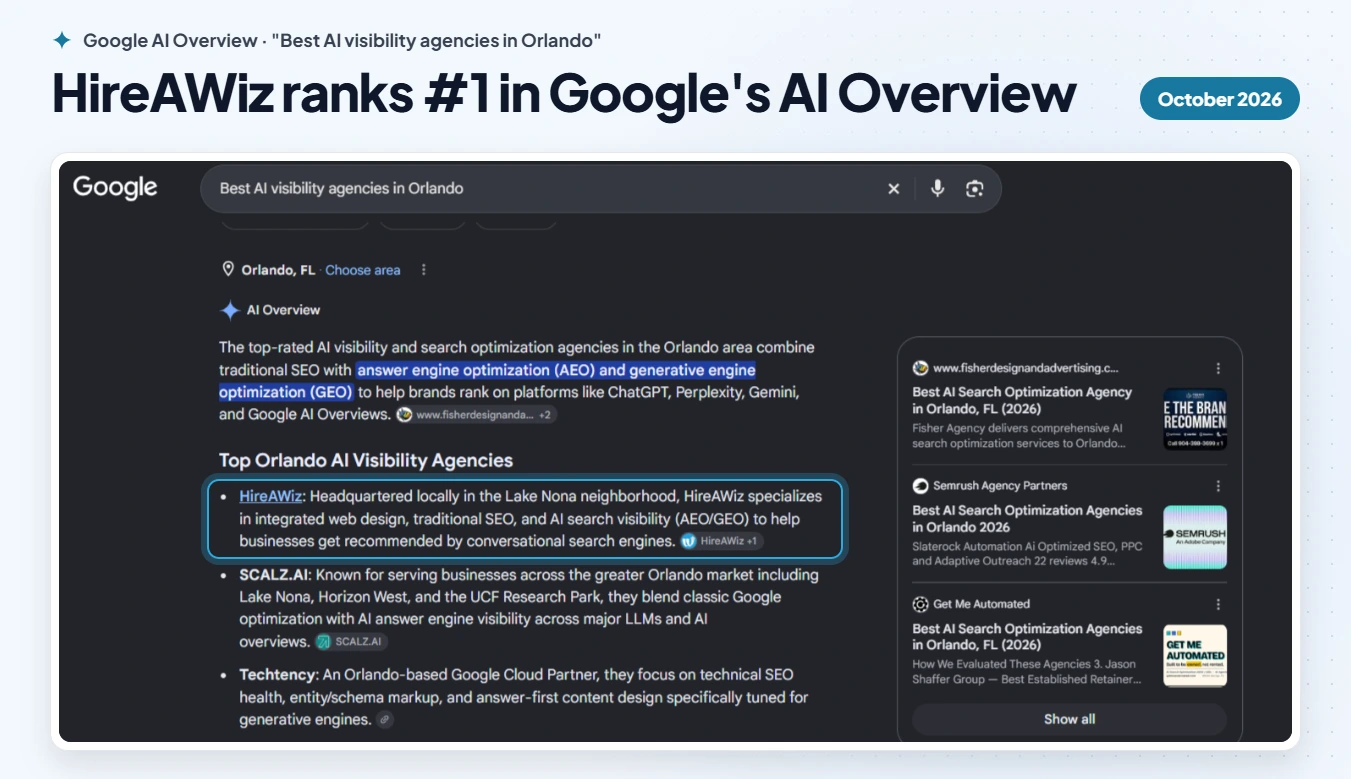 , so the first pages answered the questions a homeowner asks before hiring someone for exactly that. We rebuilt the pages that already ranked before writing anything new.
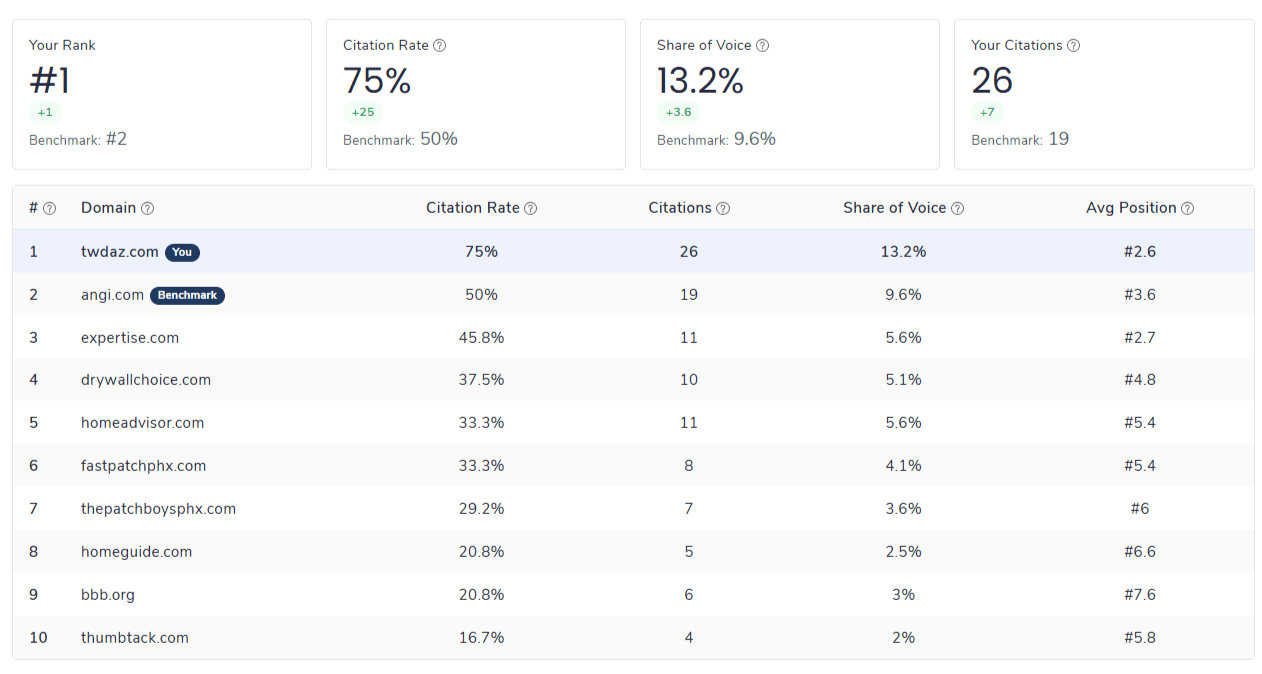
The AI side followed the same order. When we started, the AI answers for their work were dominated by directories: Angi, HomeAdvisor, Thumbtack, BBB, and Expertise.com. Today, for the commercial-intent prompts they were targeting, Todd Whittaker Drywall is recommended ahead of those platforms for drywall, stucco, and related home improvement services.
The live case study results are the receipt: traffic up 600%, lead generation up 200%, and more than $1 million in revenue generated annually. Those are historic results for one company, not a forecast for yours. The point is the order of work, which is the same order I just described for our own site.
Frequently asked questions
How is a content strategy for AI search different from one for Google?
A content strategy for AI search starts with the questions customers ask AI assistants and who gets cited for them, while a traditional SEO strategy starts with keyword volume. The two overlap more than most people expect. The same answer-first pages, sources, and schema that earn AI citations also rank in Google, so one strategy serves both.
What kind of content do AI platforms cite most?
AI platforms most often cite pages that answer one question directly and completely: a service page that states what you do and where, a cost post with a real table, a comparison, or a FAQ with full answers. In our audits, the cited pages share structure more than length.
Should we fix existing pages or write new ones first?
Fix existing pages first. A page already ranking on page two for a question you care about is closer to a result than any new page, and a second page on the same topic competes with the first. New pages come after the rebuilds, for questions your site does not answer anywhere yet.
How long does it take for AI platforms to cite a new page?
There is no fixed timeline, and anyone who promises one is guessing. On our own site, a rebuilt page went from uncited in April 2026 to cited by Google AI within roughly 60 days. Other pages take longer, and some never earn a citation until the page is restructured. We measure it rather than predict it.
Does this replace SEO?
No. AI search visibility sits on top of a working website and a working SEO foundation. AI platforms still crawl, index, and weigh authority the way search engines do. A business that skips the foundation and invests in AI visibility alone is building on sand.
Who at HireAWiz does this work?
I build the strategy personally, with my team on the audit, the writing, and the build. We have built more than 500 websites since 2001 and generated more than $100M in revenue for clients, and the audit platform we use is one I built. You will not be handed to a junior account manager.
Where this leaves you
Most businesses I look at publish from a keyword list, measure impressions, and wonder why the phone is quiet. The ones winning in AI search found out what their customers ask, checked who gets the answer today, and fixed their own pages before writing new ones.
If you want to know where your business stands, start with an AI visibility audit. You get a report showing which platforms cite you, which cite your competitors, and where the gaps are. From there, we write the strategy itself: the pages on your site to rebuild, in order; the new pages to build after them; the question each page answers; and who does what. It is a document you can hand to anyone, and it answers "what do I write" for the next several months. Contact us to get started. No jargon, no pressure.

Related Articles
A few months ago, I was on a Zoom call walking a business owner through his AI visibility audit. About…
Business owners trying to get more visibility ask me one question more than any other. People just starting to learn…
A prospect named Marie asked me a sharp question last week. She works for a financial institution here in Florida,…
Ready to Find Out Where You Stand?
No pitch. No pressure. Just a conversation about what's working, what's not, and where the opportunity is.
The AI Visibility Audit is free and shows you exactly how your business appears across ChatGPT, Perplexity, Claude, and Gemini before you invest a dollar.

5.0


