
AI Content and SEO: What Actually Works and What Quietly Fails

Business owners trying to get more visibility ask me one question more than any other. People just starting to learn SEO ask it too. "Does AI-written content hurt my rankings?"
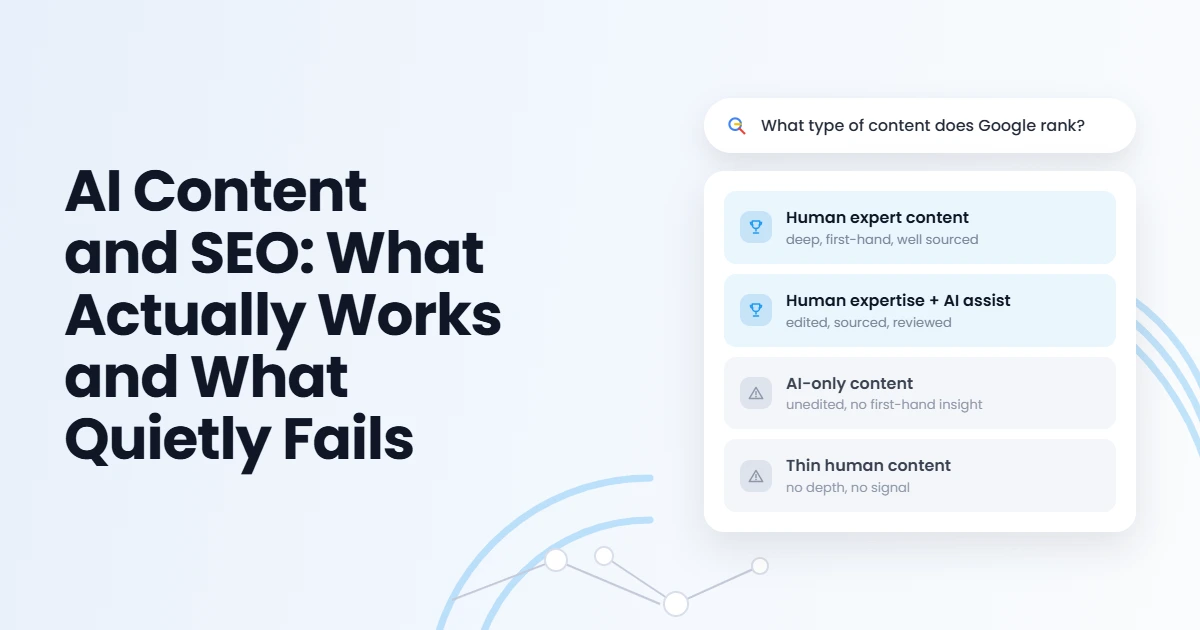
It is the wrong question, and I understand why people ask it. The right questions are whether anyone who knows your business helped produce your content and whether it adds value for your reader. That is what separates pages that bring in leads from pages that sit on your site doing nothing.
This article explains how to produce in-depth content that earns rankings and citations, with or without AI. The short version:
- Write for the person asking the question, not for the search engine.
- Match what that person is trying to accomplish, which is often not what they typed.
- Give them something they could not get from the other nine results.
- Verify every claim against a primary source before it goes live.
- Put a real, accountable name on it.
Nearly all business content today has AI somewhere in its production. Yours probably does, whether anyone told you or not. The tool does not determine the outcome. What gets put into the work before the tool runs, and what happens after, determines it.
This matters because content is not an academic exercise. Content decides whether a buyer in Orlando, across Florida, or the United States finds you when they search, whether ChatGPT names you when someone asks for a company like yours, and whether your phone rings on Tuesday. So the real question is not whether AI content hurts SEO. It is what separates the AI-assisted content that performs from the AI-assisted content that disappears.
The short answer
AI-assisted content ranks fine. Google judges content on quality, not how it was produced, and has stated that publicly since February 2023 without changing it.
What fails is content produced at volume with no real expertise behind it. That content fails for exactly the same reason thin, human-written content always failed. It gives the reader nothing they could not get from the nine other results, so nobody links to it, nobody cites it, and nothing happens.
Production method is not a ranking factor. What you know about your own business is.
Why your AI-written blog got no traffic
Most business owners have already run this experiment. You published six or eight posts, waited three to four months, saw no movement, and quietly stopped.
Nothing went wrong in the way people expect. Your site was not penalized. No warning appeared in Search Console. The content was accurate, readable, and entirely reasonable.
The actual problem was that the content was indistinguishable from everything else on the topic. What a model produces is a synthesis of what has already been published. Feed it a topic your competitors have covered, and you get a competent restatement of their material with your logo on top. Google has no reason to rank it above the sources it was drawn from. AI platforms have no reason to cite it when the original sources exist.
Four other failures show up regularly:
- Wrong intent. Models guess at what the reader wants and often guess wrong, producing an article that answers a question nobody in your market is asking.
- Confident errors. Models invent statistics and misattribute facts. A wrong number costs you more than a ranking when a customer catches it.
- Volume with no plan. Production got cheap, so businesses publish forty posts where they used to publish four. Your own pages start competing for the same query, and nobody decided what each page is for. This is the one path by which an ordinary business drifts toward the scaled content abuse policy described below.
- Stale references. Models train on old data, so they write about Google My Business, Universal Analytics, and features retired years ago. A prospect who spots that assumes the rest of your site is equally out of date.
None of this registers as a penalty. It registers as nothing happening, which is harder to diagnose and easier to keep investing in.
And when content does start ranking, one more failure waits. Traffic without a next step produces nothing. If a page brings in two hundred visitors a month and never tells any of them what to do, it is a cost center that happens to have good analytics.
What Google has said about AI content, and never taken back
Most of what circulates on this subject is secondhand, so the documentation is the place to settle it.
In February 2023, Google Search Central published guidance(opens in new tab) stating that appropriate use of AI or automation is not against its guidelines. Google said it focuses on content quality, not how it is produced. Google drew an analogy in that same guidance: a decade earlier, similar concerns arose about mass-produced human-written content, and banning all human writing was never a sensible response.
In March 2024(opens in new tab), Google renamed "spammy automatically generated content" to scaled content abuse(opens in new tab). The policy targets generating many pages primarily to manipulate rankings instead of helping users, and Google said it applies whether content is produced through automation, human effort, or a combination of the two.
That policy is method-agnostic on purpose. Twelve human writers producing thin, templated location pages violate it. One well-researched, AI-assisted article that answers a real question does not. Three conditions have to be present together:
- Volume
- Manipulative intent
- Low value to the reader
Miss any one of the three, and the policy does not describe your site.
What the Claude watermark means for your rankings
On August 10, 2026, Anthropic updated a support page(opens in new tab) confirming that Claude now embeds an invisible, machine-readable watermark into the text it generates. Within a day, "AI text can now be marked" had turned into "Google is going to bury every page that touched AI."
The source material says something narrower.
Anthropic states that when a mark is found, it indicates the content may have been processed by Claude. Not written by. Processed by. The company lists proofreading, translating, summarizing, and converting files as cases where output carries a mark even though the ideas and the writing came from a person. A marketing manager who writes an original article from her own experience, then runs it through Claude to fix her commas, produces marked text.
The signal fails in the other direction too. Anthropic states plainly that the absence of a mark does not mean content was human-written.
| A mark means | No mark means |
|---|---|
| Claude touched the text at some stage | Nothing. AI may still have been used. |
| The mark can survive copying, pasting, and some editing | Heavy paraphrasing strips the mark |
| Proofreading and translation alone can produce it | Short passages leave too little text to read |
| It says nothing about who did the thinking | Models released before marking carry nothing |
The detection tooling has not shipped yet. Anthropic says it will publish documentation and support third-party detection. That documentation does not exist today.
Then the detail that should end the conversation. Google has been watermarking its own AI text since 2024. Google DeepMind deployed SynthID-Text(opens in new tab) across the Gemini app, published the method, and released the code. Google signed the same European transparency code(opens in new tab) Anthropic did, three weeks earlier. In two years of having this capability in-house, Google has never used a text watermark as a ranking signal, never mentioned watermarks in any content guidance, and never suggested marked text ranks differently from unmarked text.
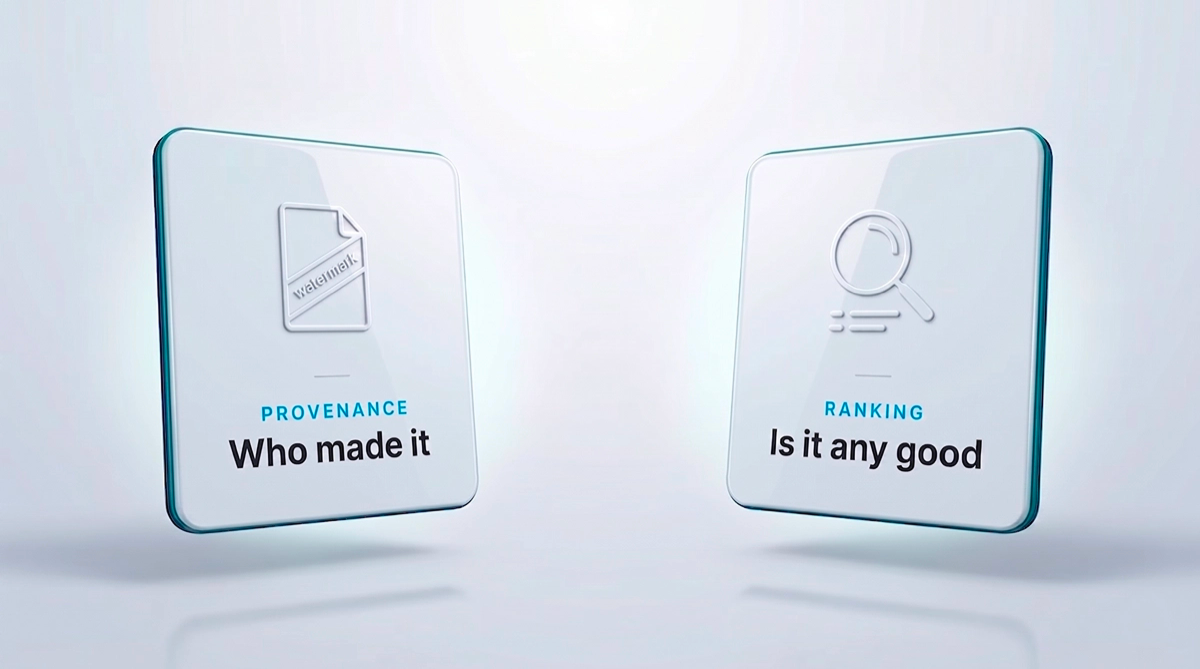
Provenance answers where something came from. Ranking answers whether it is any good. They are separate questions, and only the second one affects your traffic.
Which brings the subject back to where it started. Content that demonstrates real experience, verifies its facts, serves the person who asked, and carries a real name will rank whether AI helped produce it or not. Content that does none of those things will fail whether AI helped produce it or not. E-E-A-T has outlasted every core update, every format change, and now an entire provenance standard, because it was never a tactic. It describes whether a real person with real knowledge made something a reader is better off having read.
What determines whether content ranks and gets cited
Four things, in rough order of how much they matter.
Experience only your business has
Any model can tell a reader what commercial roofing runs per square foot on average. None of them knows that your crews will not take a job under 4,000 square feet, or that your buyers are property managers and not owners. No model was on the Winter Park project last March when it went sideways, and no model knows what you changed after.
Google's own guide to optimizing for generative AI features(opens in new tab) draws this line explicitly. It separates commodity content built on common knowledge from non-commodity content carrying an expert or first-hand take, and tells site owners not to publish what a generative AI model could have produced on its own.
Google calls this Experience, the first E in its E-E-A-T framework(opens in new tab), and it is the pillar AI cannot supply. It is also the reason a reader keeps reading. Specifics only you have are the entire competitive advantage of your content, and most content programs never collect them.
Verified accuracy against primary sources
We check every figure, date, name, and claim against the source, not against another blog that cited a blog. Models produce confidently wrong numbers, invent statistics, and describe platform behavior that stopped being true two years ago.
The rule is simple. Cut claims that will not survive checking. Do not hedge them. This is slow, unglamorous work, and it is what makes a page citable.
Structure that machines can extract
Google and AI platforms both pull from pages built the same way:
- Clean heading hierarchy, with each section covering distinct ground.
- Direct answers near the top of a section, not buried in paragraph four.
- Real author attribution on a real author page with real credentials. Google specifically advises against giving AI a byline.
- Structured data that matches what is visible on the page.
- A page that loads fast, works on a phone, and keeps the main content easy to find.
Google generates the jump-to-section links you sometimes see under a search result from pages built this way. AI platforms pull citations from pages built this way. Neither is a watermark question. Both are structure questions.
Reader intent: you know it, a model guesses
The question behind the search term is frequently not the question typed. A model has no idea that your buyers are procurement officers, or that a compliance department vetoes the obvious recommendation. The objection killing half your deals appears in no published article on the topic. You supply that. The draft gets built around it.
All four assume the page itself holds up. Good content on a slow, cluttered, or broken page underperforms, and Google's generative AI guide says so directly: a page has to be indexed, eligible to show with a snippet, and deliver a good page experience(opens in new tab) across devices with low latency and a clear line between main content and everything else. A 3,000-word article that takes six seconds to load on a phone, buries its answer under a hero slider, or breaks its heading hierarchy in a page builder has given away most of what the writing earned. That is why web design and SEO sit under the same roof here. The page is part of the content.
Notice that AI is compatible with all four. It cannot originate the first one, and the first one is what your buyer is responding to.
| AI carries well | Stays with a person |
|---|---|
| Research synthesis before you form a point of view | The point of view itself |
| Outlining and structure | Which questions your customers ask, and why |
| First drafts where the facts are settled | Anything that happened on a job, a call, or a project |
| Editing passes and repurposing finished work | Verifying every claim against its source |
| Tightening a headline | Approving the piece and putting a name on it |
Four checks before anything gets published
Google's helpful content documentation(opens in new tab) offers site owners a self-assessment built on three questions: who made this, how was it made, and why does it exist. Four checks cover those questions in practice, which is why they hold up regardless of what ships next quarter.
| Check | The Google question it answers | What it means for your content |
|---|---|---|
| Accuracy | Does the page present information in a way that makes a reader want to trust it? | Trace every figure, date, and claim to a primary source. Cut what cannot be confirmed. |
| Relevance | Why does this page exist? Google calls this the most important question. | The page exists to help a specific person accomplish something, not to catch a query. |
| Voice | Does it provide original information, reporting, or analysis? | It says something only your business could say, in a voice that sounds like your business. |
| Ethics | Is the use of automation clear to a visitor who would reasonably wonder? | Disclose AI use where a reader would expect it. Keep confidential business information out of AI tools unless your agreements allow it. |
The fourth check catches businesses off guard. Customer data, pricing, and internal documents pasted into an AI tool are contract and security questions, not search questions, and enterprise buyers ask about them directly.
There is a fair objection to all of this. Not every business has a writer on staff, and plenty of owners are good at the work without being especially good at the writing. That is a real constraint, and there are two reasonable ways around it:
- Bring in a specialist for the pieces that matter most. Service pages, pillar content, and the case studies you send to high-value prospects. We have worked with the same copywriter for about ten years. He is not the cheapest option, and he delivers finished work with little back-and-forth.
- Handle it in-house and let expertise carry it. Write plainly about the things you know. Your first advantage is what you know, not polished prose. Quality tends to follow.
Either way, AI changed how quickly a draft appears. It did not change who is accountable for whether that draft lands with the reader.
How we produce content at HireAWiz
Since I am asking you to evaluate the company writing your content, it is fair to describe how we write ours.
Every piece starts with knowledge that exists inside the client's business. How we get it out depends on how much time the client has:
- Interview. We record a conversation with the owner, founder, or whoever holds the expertise, transcribe it, and an editor shapes it while keeping the speaker's voice. Best for clients who explain things well out loud and do not want to write.
- Written intake. We send targeted questions the client answers on their own schedule.
- Full research. For clients who cannot spare the time for either, we do the work ourselves. We research the company, its ideal customer, what sets it apart, and its market, then bring back what we found for the client to confirm and correct. This is the larger investment, and it is how we produce thought leadership built to earn rankings and citations without asking a busy owner to write a word.
From there, every path runs the same eight steps:
- Extract the expertise. Interview, intake, or our own research, as above.
- Decide what to write. Analytics, search data, and a competitive gap analysis show which questions your market asks that nobody has answered well.
- Build the outline with the client. Nothing gets written until the outline is approved.
- A writer who knows the industry drafts it. Aaron or Becky writes in the client's brand voice, not a generic one.
- Infuse the client's first-hand experience. Job specifics, numbers only the business has, the objection that kills deals. This is the step a model cannot do and the step most content programs skip.
- Client review and sign-off.
- Optimize for SEO and AEO. Heading hierarchy, direct answers, author attribution, structured data, and a page that loads fast on a phone.
- Publish and distribute. A post nobody sees does no work. Plan distribution before publication, not after.
AI assists throughout: research synthesis, structuring, drafting sections where the facts are settled, editing passes. Every factual claim is verified against a primary source. A named person writes it, a named person approves it, and the client's name goes on it.
Google's guidance on using generative AI content(opens in new tab) suggests disclosing AI use where a reader would reasonably wonder about it, so consider this disclosure. This article was produced the same way, and every claim in it traces directly to Google, Anthropic, or Google DeepMind, never to secondary coverage.
The same principle runs through how we handle audits. Software collects the data. Twenty-five years of building websites and search strategies supplies the interpretation, the prioritization, and the recommendation you will actually act on. Nobody pays for data. They pay for what someone makes of it.
What that produces
Rankings are a vanity metric until something happens, so here are both halves.
The captures below are from August 12, 2026, for the query "best ai visibility agency orlando."
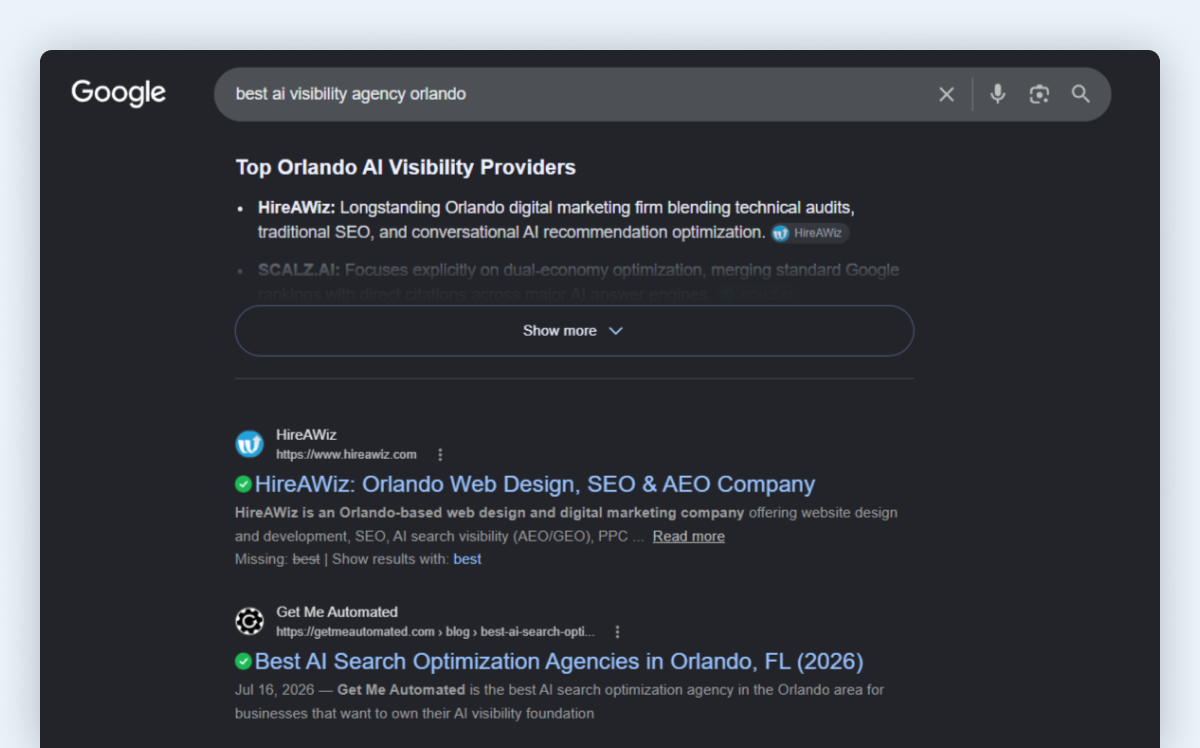
Google's AI Overview names HireAWiz first among top Orlando AI visibility providers and describes us as a longstanding Orlando digital marketing firm blending technical audits, traditional SEO, and conversational AI recommendation optimization. Google assembled that description from our own pages.
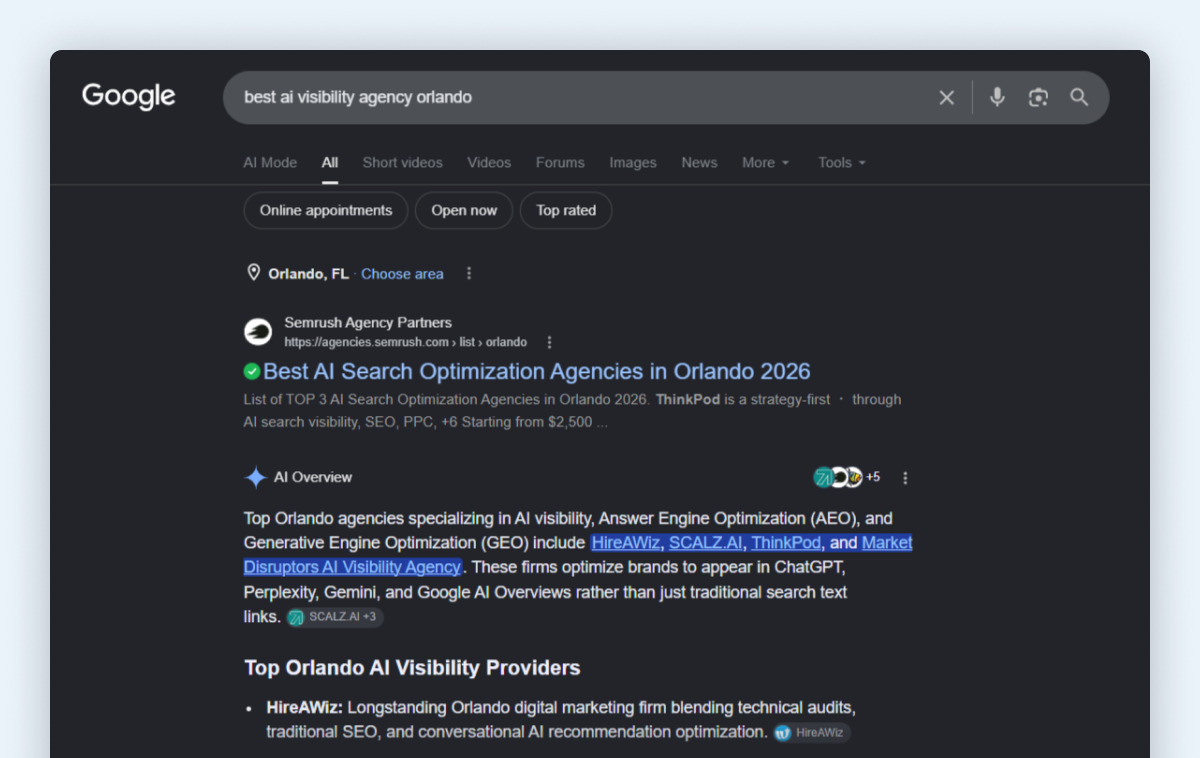
The same query in organic search.
Note how short that window is. The pages producing those results, including our answer engine optimization service page, went live in Q2 2026. They have been up for months, not years, and they are already placing against domains with far more authority. AI Overviews are non-deterministic, so running that query yourself may return something different. That is the same likelihood-not-guarantee framing we give every client, and it applies to our own results as much as anyone's.
Then the part that matters. An enterprise prospect we cannot name under NDA found us through those results. Not a referral. Not an ad. They read the pages, arrived at the first call already convinced we knew the subject, purchased an AI visibility audit, and are now in procurement on an ongoing advisory engagement.
Every page that produced that outcome was written with AI assistance, human direction, and independent fact-checking. Including this one.
The standard has not changed
Strip away every headline about AI and content, and what remains is the bar that applied long before any of us had a language model.
Does the content inform someone? Do they finish it? Does it give them something they could not get from the other results? Does it match what the person was trying to accomplish when they typed the search?
Know your subject. Write for the person asking the question. Say something only your business could say. Verify every claim. Put a real name on it and mean it.
Content built that way tends to rank. It also tends to convert, because the qualities that make a customer trust you are the same ones that make a search engine trust you. Chase the ranking alone, and you get thin pages that place for a while. Serve the reader properly, and you usually get both.
The tools changed how fast a draft appears. They did not change who has to know the answer.
See where your business stands
Wondering whether your business shows up when someone asks ChatGPT, Perplexity, Claude, or Google's AI Overviews for a company like yours? We run the same audit on your website that we ran on our own.
Frequently asked questions
Does AI-written content hurt SEO?
No. Google judges content on quality, not production method, a position it has published since February 2023. AI-assisted content that demonstrates real expertise, verifies its facts, and answers a genuine question performs the same as any other well-made content. AI-assisted content that restates what is already published performs poorly, as does human-written content that does the same.
Will Google penalize my website for using AI?
Google penalizes scaled content abuse, defined as generating many pages primarily to manipulate rankings while providing little value to users. The policy applies whether content is produced through automation, human effort, or a combination. Volume, manipulative intent, and low value must all be present for the policy to describe your site.
Why isn't my AI-written blog getting any traffic?
Most often because it restates information already published elsewhere. A model synthesizes existing material, so without specific knowledge from inside your business, the result reads as a competent version of what your competitors already published. Search engines have no reason to rank it above the original sources, and AI platforms have no reason to cite it.
Should I ask my marketing company whether they use AI?
Asking whether they use AI tells you very little, since nearly everyone does at some stage. More useful questions are how they collect expertise from inside your business and who verifies factual accuracy against what sources. Ask which named person writes the work, who approves it, and whose byline appears on the published piece.
Do I need to disclose that AI helped write my content?
Google recommends AI or automation disclosures for content where a reader might reasonably wonder how it was created, and treats this as a quality consideration rather than a ranking requirement. Google separately advises against listing AI as the author byline. Contractual and regulatory obligations are a separate question to review with counsel.
Does the Claude watermark affect my search rankings?
No. Production method does not appear as a ranking input anywhere in Google's published documentation, and no search engine has said it reads text watermarks. The signal is unreliable in both directions anyway. A mark can survive editing, so it may appear on work a person rewrote, and its absence does not mean AI was uninvolved.
Can AI-assisted content get cited by ChatGPT and Google AI Overviews?
Yes. AI platforms select sources based on entity clarity, corroboration across third-party sources, extractable page structure, and demonstrated expertise. None of those inputs relates to how the content was drafted. Pages built with clear headings, direct answers, real author attribution, and information that exists nowhere else are the ones that get cited.
About Clifford Almeida
Clifford Almeida is the founder of HireAWiz, an Orlando web design and digital marketing company he started in 2001. He also created My Web Audit, an audit platform hundreds of companies worldwide use to evaluate websites, SEO, and AI search visibility, which has generated more than 100,000 audits. Over 25 years, he has led work behind 500-plus websites and more than $100M in client revenue, including projects for Cox Communications, General Dynamics, the National PTA, and the U.S. Attorney's Office.

Related Articles
A prospect named Marie asked me a sharp question last week. She works for a financial institution here in Florida,…
I gave a presentation last week to a company weighing whether to invest in SEO and AI search visibility. The…
A longtime HireAWiz client, I’ll call her Jane, came to me recently with new website content she had built with…
Ready to Find Out Where You Stand?
No pitch. No pressure. Just a conversation about what's working, what's not, and where the opportunity is.
The AI Visibility Audit is free and shows you exactly how your business appears across ChatGPT, Perplexity, Claude, and Gemini before you invest a dollar.

5.0


